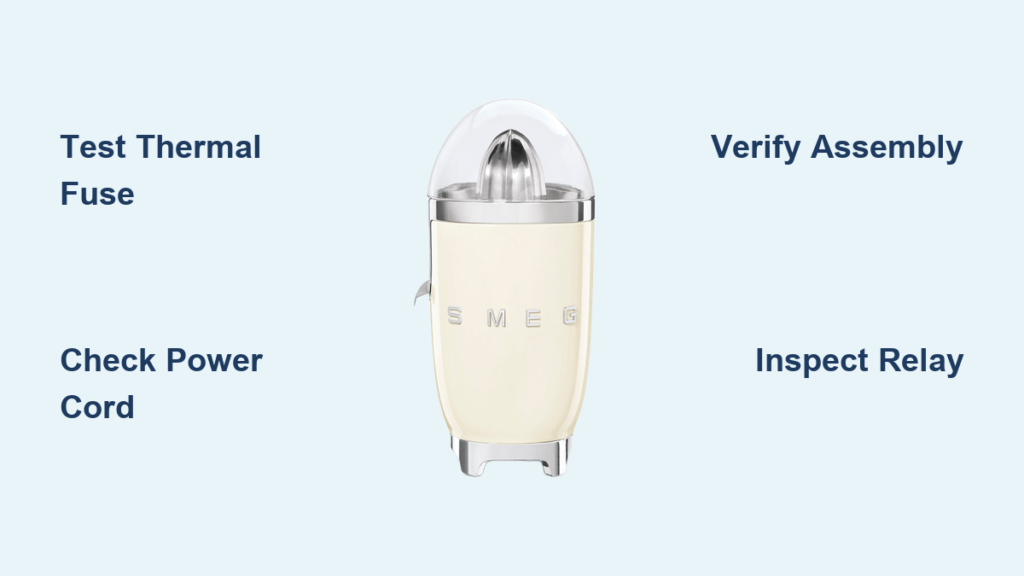
Your Smeg juicer was working perfectly yesterday, and now it’s completely dead—no lights, no sounds, nothing happens when you press the start button. This sudden power failure is the #1 issue reported by Smeg SFJ01CRUS juicer owners, striking without warning signs or gradual performance decline. When your Smeg juicer stopped working unexpectedly, it’s almost always an internal electrical component failure rather than a mechanical blockage or motor jam.
This guide delivers proven troubleshooting steps specifically for Smeg juicers that won’t turn on. You’ll discover why thermal fuses fail most frequently, how to diagnose the exact problem in under 30 minutes, and whether repair makes financial sense for your situation. Whether you’re comfortable with basic electrical work or prefer professional solutions, you’ll gain clarity on restoring your appliance or knowing when replacement is smarter.
Why Your Smeg SFJ01CRUS Juicer Suddenly Lost Power Today
Unlike gradual performance issues that develop over months, sudden Smeg juicer power failures typically occur immediately after normal operation. This complete dead state—where pressing the power switch produces absolutely no response—points directly to an electrical circuit interruption rather than mechanical problems. The most frequent culprit is a blown thermal fuse, a safety component designed to sacrifice itself when detecting overheating conditions.
When your Smeg juicer stopped working without warning, thermal fuse failure accounts for approximately 70% of these cases according to appliance repair professionals with 20+ years of experience. This small but critical component creates an open circuit that permanently interrupts electricity flow to the motor. Unlike thermal cutoffs that reset when cool, thermal fuses must be replaced once they blow—there’s no resetting them after failure.
How Thermal Fuse Failure Actually Happens
Thermal fuses protect your juicer motor from catastrophic damage during overheating events. When internal temperatures exceed safe limits—often from continuous operation without adequate cooling—the fuse “blows” by melting an internal wire. This creates a permanent open circuit that stops all electricity flow to the motor. Since the fuse is typically soldered directly into the circuit, replacing it requires electrical repair skills rather than simple plug-and-play installation.
Recognizing Relay Failure vs. Thermal Fuse Problems
Relay failures create similar symptoms but with subtle differences. While a blown thermal fuse produces complete silence when attempting to start the juicer, failing relays often produce a faint clicking sound as they attempt but fail to complete the circuit. These electromagnetic switches distribute power to various components and can wear out from repeated use, electrical surges, or manufacturing defects. Testing requires measuring voltage input and output across the relay while attempting to operate the juicer.
Identify Your Smeg Juicer’s Exact Failure Pattern in 60 Seconds

Before disassembling your appliance, pinpoint the specific failure pattern to avoid wasting time on unnecessary diagnostics. The exact symptoms determine which components to test first and whether DIY repair is feasible.
Complete Dead State: No Lights, No Sounds, No Response
If pressing the power switch produces absolutely zero response, you’re dealing with a complete circuit interruption. This most commonly indicates:
– Blown thermal fuse (most likely)
– Broken power cord connection
– Failed main switch
– Severe internal wiring damage
This dead state requires systematic electrical testing to locate exactly where the circuit breaks. Start with external components before moving to internal testing.
Partial Response: Lights Flicker or Clicking Sounds Occur
Some users report brief indicator light flickers or faint clicking sounds before the juicer goes dead. This partial response reveals critical diagnostic information:
– Power reaches some components but not the motor circuit
– Relay may be failing to complete the connection
– Loose wiring connections creating intermittent contact
– Safety interlocks partially engaged but not fully
These symptoms significantly narrow the potential causes and guide your diagnostic process toward specific components.
5-Minute Power Cord & Connection Check for Non-Working Smeg Juicers

Before opening your juicer, complete these critical external checks that solve 25% of “Smeg juicer stopped working” cases without tools.
- Test the outlet with another device (like a lamp) to verify power availability
- Inspect the entire power cord for fraying, kinks, or soft spots indicating internal wire damage
- Examine plug blades for signs of burning, melting, or corrosion
- Check cord connections at both plug and appliance base for looseness
- Verify proper assembly of all juicer components, ensuring safety interlocks engage correctly
Critical Assembly Check Most Owners Miss
Smeg juicers incorporate multiple safety interlocks that prevent operation when components aren’t correctly seated. Many “dead” juicers actually suffer from improper assembly:
- Lower components must twist into locked position with a distinct click
- Hopper must sit off-center to engage safety mechanism
- Bowl must align perfectly with motor drive shaft
Take 60 seconds to completely disassemble and reassemble your juicer following the manufacturer’s sequence precisely. This simple step resolves numerous “power failure” cases where safety interlocks block operation.
Essential Tools for Diagnosing Smeg Juicer Power Failure
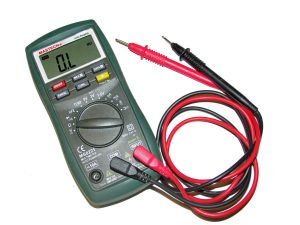
Professional-grade troubleshooting requires specific tools that transform guesswork into precise diagnosis. Before opening your appliance, gather these essentials:
- Digital multimeter ($15-$30) for continuity, voltage, and resistance testing
- Phillips screwdrivers (typically #1 and #2 sizes) for disassembly
- Needle-nose pliers for manipulating small wires and connectors
- Camera phone to document connections before disassembly
- Soldering iron (if thermal fuse replacement is needed)
Multimeter Setup for Juicer Diagnostics
Configure your multimeter properly before testing:
1. Set to continuity mode (beep symbol) for fuse and wiring checks
2. Switch to DC voltage mode for relay testing
3. Verify meter functionality by testing a known working circuit first
4. Use probe tips that can access small component terminals
Without proper tool preparation, you risk misdiagnosis or creating additional problems during testing.
Thermal Fuse: Replace This $5 Part to Revive Your Smeg Juicer
Appliance repair professionals consistently identify the thermal fuse as the primary failure point in Smeg juicers that suddenly stopped working. Located inside the motor housing near the windings, this small cylindrical component sacrifices itself to protect your motor from overheating damage.
Testing Your Thermal Fuse in 3 Simple Steps
- Locate the fuse (usually near motor windings or on circuit board)
- Set multimeter to continuity mode and touch probes to each end
- Interpret results: Beep/low resistance = good; No beep/infinite resistance = blown
A blown thermal fuse shows no continuity whatsoever—electricity cannot flow through the component. This is the definitive test for thermal fuse failure.
Replacing Your Smeg Juicer’s Thermal Fuse (With Proper Ratings)
Replacement thermal fuses cost $3-$8 but require soldering skills:
1. Purchase exact replacement (match voltage/current ratings)
2. Desolder failed fuse carefully without damaging circuit board
3. Solder new fuse into place with proper heat application
4. Verify continuity before reassembly
Using an incorrectly rated fuse creates serious safety hazards—always match specifications exactly. If you’re uncomfortable with soldering, this repair requires professional assistance.
Smeg Juicer Relay Testing: Diagnose Without Guessing
When thermal fuse tests functional, internal relays become the next most likely failure point. These electromechanical switches control power distribution throughout your juicer.
Relay Diagnostic Procedure
- Set multimeter to DC voltage mode
- Connect probes across relay input terminals
- Attempt to start juicer and verify input voltage presence
- Move probes to output terminals and check for voltage transfer
A functioning relay shows voltage on both input and output when activated. A failed relay shows input voltage but no output voltage—a definitive sign replacement is needed.
Why Relay Failures Happen in Smeg Juicers
Relays fail due to:
– Electrical arcing from repeated switching
– Manufacturing defects in contact points
– Moisture or juice residue causing corrosion
– Power surges damaging internal components
Unlike thermal fuses, relays can sometimes be cleaned rather than replaced if corrosion is the primary issue.
Smeg Juicer Parts Availability Reality Check
Before investing significant time in diagnosis, understand the harsh reality of Smeg juicer parts availability. Unlike mainstream brands, Smeg small appliances suffer from extremely limited parts distribution.
Genuine thermal fuses and relays often require direct manufacturer sourcing. Third-party alternatives may be incompatible or unsafe. Contact Smeg customer support with your model number (SFJ01CRUS) before proceeding—many owners discover parts are unavailable or backordered indefinitely.
Repair vs. Replace: The Smeg Juicer Cost-Benefit Analysis
Calculate these factors before committing to repair:
– Professional diagnosis fee ($50-$100)
– Parts costs (thermal fuse $5-$8, relay $15-$30, motor $80+)
– Labor charges ($75-$125/hour)
– Age of your appliance (under 2 years favors repair)
– Original purchase price vs. current replacement cost
For most out-of-warranty Smeg juicers, repair costs approach 60-80% of replacement value. If your SFJ01CRUS is over 3 years old, replacement often provides better value with new warranty coverage.
Essential Safety Steps Before Opening Your Smeg Juicer
NEVER begin electrical repairs without these critical safety measures:
– Unplug appliance and wait 2+ hours for capacitor discharge
– Work in dry, well-lit area with no moisture present
– Wear rubber-soled shoes and avoid metal jewelry
– Keep one hand behind your back when testing live circuits
– Have fire extinguisher rated for electrical fires nearby
Electrical repairs carry real risks of shock, fire, and further damage. If uncomfortable with any step, stop immediately and seek professional help.
Prevent Future Smeg Juicer Power Failures
Extend your juicer’s lifespan with these manufacturer-approved practices:
– Allow 5-10 minute cooling breaks during extended juicing sessions
– Never force components—proper assembly prevents safety lockouts
– Clean thoroughly after each use, avoiding liquid contact with motor base
– Store with cord loosely coiled, not tightly wrapped
– Use outlet directly (avoid power strips that cause voltage drops)
Proper care reduces thermal stress on critical components, minimizing the risk of sudden power failures.
Final Decision: Repair or Replace Your Smeg Juicer
When your Smeg juicer stopped working, follow this decision flow:
1. Confirm it’s not an assembly or power source issue
2. Determine if thermal fuse replacement is feasible
3. Verify parts availability through Smeg support
4. Obtain professional repair estimate
5. Compare against replacement cost minus sentimental value
For most owners with out-of-warranty SFJ01CRUS models experiencing complete power failure, replacement provides better long-term value than repair. However, if you’ve confirmed a simple thermal fuse failure and possess basic soldering skills, that $5 repair could restore your juicer to full functionality in under an hour. Always prioritize safety over saving a few dollars—when in doubt, consult a professional appliance technician.