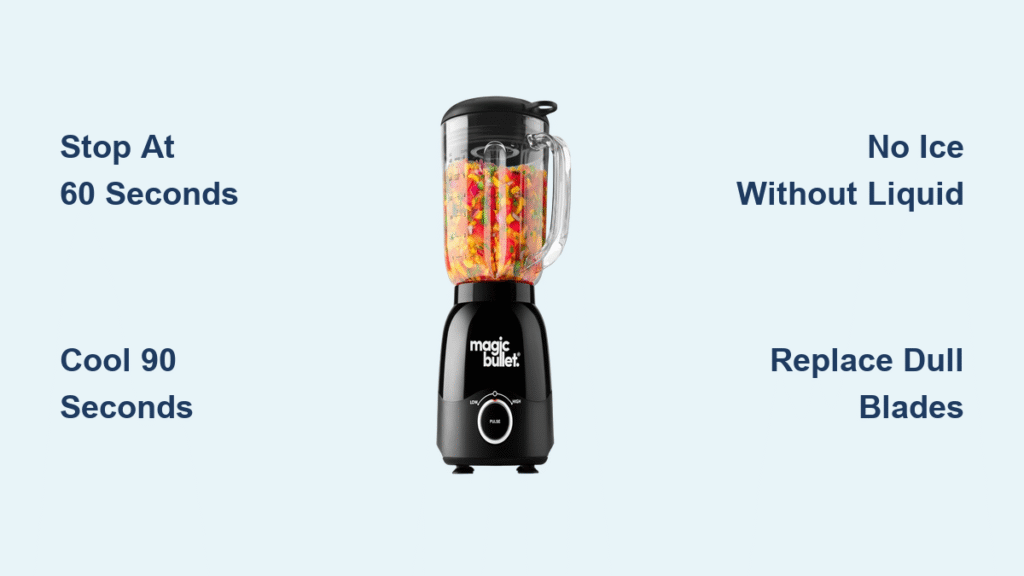
Your Magic Bullet sputters to a halt mid-smoothie, the base radiates intense heat, and a sharp burning smell fills your kitchen. Before you assume it’s dead, know this critical fact: every Magic Bullet blender is designed to overheat and shut down after 60 seconds—it’s a built-in safety feature, not a defect. But when it dies at 20 seconds or emits smoke? That’s dangerous territory. This guide reveals exactly how to diagnose real overheating threats, perform immediate damage control, and implement foolproof prevention strategies to protect your motor for years.
Why Your Magic Bullet Shuts Off After Exactly 60 Seconds
Your Magic Bullet’s thermal safety circuit isn’t failing—it’s actively protecting the 250-watt motor from destruction. When continuous blending reaches 55-65 seconds, the thermal switch automatically cuts power to prevent enamel insulation on motor windings from melting. This isn’t random; it’s engineered physics. Without this safeguard, sustained operation would warp plastic housings and cause electrical shorts within minutes.
Spot normal operation instantly:
– ✅ Shutdown occurs precisely at 60 seconds with no warning sounds
– ✅ Base feels warm but not scalding (under 140°F)
– ✅ Unit restarts fully after 1-2 minutes unplugged
– ❌ Smoke, acrid odors, or failure to restart indicate critical failure
This safety mechanism buys you time—but only if you respect its limits. Ignoring these shutdowns risks permanent motor burnout.
Early Shutdown: Diagnose Dangerous Overheating Before It’s Too Late

If your Magic Bullet dies before 60 seconds, these hardware failures are actively cooking your motor. Don’t mistake these for normal operation—they signal imminent failure.
Shuts Down Between 20-40 Seconds? Check Motor Windings
Shorted windings or degraded insulation cause the motor to draw excessive current, generating heat 3× faster than normal operation. You’ll notice reduced blending power before shutdown. Critical test: Unplug, let cool, then pulse for 5 seconds. If it struggles to spin frozen berries that normally blend easily, windings are failing. Replace the base immediately—continued use risks fire.
Immediate Shutdown on Startup? Clear Mechanical Jams Now
A locked blade shaft (from ice chunks or food debris) forces the motor into “stall mode,” converting all electrical energy into heat within seconds. Emergency action: Unplug, invert the cup, and inspect the blade assembly. Remove any obstructions wedged between blades and cup walls. If blades spin freely by hand but still trigger instant shutdown, the gear mechanism is stripped—requiring replacement.
Intermittent Tripping? Hunt for Electrical Faults
Cracked solder joints in the thermal switch cause erratic shutdowns as heat expands connections. Similarly, loose outlet plugs create dangerous resistance points that overheat the cord. Diagnostic trick: Plug into a different outlet and monitor voltage with a multimeter (should read 110-125V). If tripping persists, internal wiring damage has likely occurred—discontinue use.
Cordless Models Dying Early? Test Battery Health
Overheated Li-ion cells trigger internal protection circuits at lower temperatures, mimicking motor failure. Quick check: After shutdown, feel the battery compartment. If it’s hotter than the motor base, battery degradation is the culprit. Replace the battery pack—never attempt to recharge an overheated unit.
Smoke or Burning Smells? Execute This Emergency Protocol
Stop blending immediately if you detect smoke or burning odors—this indicates active component failure. Every second counts to prevent fire:
- YANK THE PLUG – Don’t wait for auto-shutoff; physically disconnect power
- Move to ventilated area – Open windows and turn on exhaust fans
- Inspect base vents – Look for melted plastic or warped housing (discontinue use if found)
- Never restart – Even after cooling, internal damage is irreversible
Decode the danger by smell:
– 🔥 Electrical/burning plastic odor: Melting wire insulation (fire risk)
– ⚡ Metallic/ozone smell: Carbon brush arcing inside motor
– 🧪 Sweet chemical scent: Overheating housing plastic
Units emitting smoke require warranty replacement or disposal—never attempt repair.
Crush Ice Without Cooking Your Motor: 3 Overload Killers
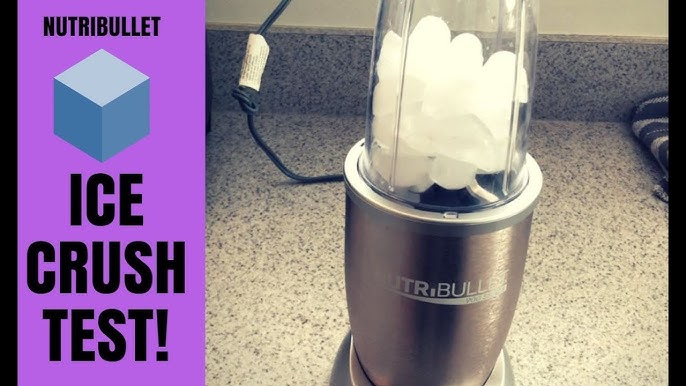
Most Magic Bullet overheating stems from mechanical overload. These common mistakes push motors beyond thermal limits:
Ice Crushing Without Liquid
Blending solid ice cubes without liquid creates “locked-rotor” conditions where current draw spikes 5× normal. Fix: Always add ½ cup liquid first, then ice. Pre-chill liquid to maintain cold temperatures.
Overfilled Cups
Exceeding the MAX line (≈400mL) increases viscous drag on blades, forcing the motor to work 40% harder. Fix: Never fill above the MAX line—reduce batch sizes for thick blends.
Dull Blades
Nicked or bent blades require 30% more torque to cut through ingredients, generating excess heat. Pro tip: Replace blades every 6-9 months. Test sharpness by slicing through a strawberry—if it crushes instead of cuts, blades are worn.
Prevent Overheating in 60 Seconds Flat: Usage Rules That Work
Follow these non-negotiable limits to keep your Magic Bullet running cool:
| Critical Limit | Action Required |
|---|---|
| Max run time | 60 seconds (stop at 55s for safety margin) |
| Cooling break | Unplugged 90 seconds minimum between batches |
| Frozen prep | Thaw 5 minutes or cut fruit into ≤1cm cubes |
| Liquid ratio | 1:1 liquid to solids minimum (e.g., ½ cup milk + ½ cup berries) |
| Batch size | Never exceed MAX line—fill only ¾ full for thick blends |
Game-changing technique: For frozen smoothies, add liquid FIRST, then solids. This creates immediate blade lubrication, preventing stall conditions that trigger overheating.
New Unit Break-In: Avoid Early Overheating
New Magic Bullets may emit a light varnish odor during first uses—this is normal motor coating burn-off. Skip this critical step, and you risk premature overheating:
- Fill cup with 250mL warm water + 1 drop dish soap
- Pulse in 10-second bursts (30 seconds total max)
- Rinse thoroughly and air-dry overnight
- Never run dry during initial uses
This seats carbon brushes and distributes lubricants, reducing operating temperature by 15°F.
Troubleshooting Cheat Sheet: Fix Overheating in 5 Minutes

| Symptom | First Action | Solution |
|---|---|---|
| Dies at 60s exactly | Wait 2 min, restart | ✓ Normal operation |
| Dies at 30s + grinding noise | Remove cup, spin blade by hand | Clean/replace blades |
| Smoke + won’t restart | Unplug, inspect base | Warranty claim |
| Slow speed + burning smell | Check blade sharpness | Replace cross blade |
| Cordless dies early | Test battery voltage | Replace battery pack |
Critical mistake: Ignoring brief cooling breaks between batches. Back-to-back blending without 90-second pauses is the #1 cause of preventable motor burnout.
Monthly Maintenance That Cuts Operating Temperature
Prevent heat buildup with these 5-minute routines:
– Daily: Rinse blade assembly immediately after use—dried food residue forces 20% higher torque
– Weekly: Deep-clean cup threads with toothbrush; debris here misaligns the cup, increasing drag
– Monthly: Apply one drop food-grade mineral oil to blade spindle (accessible models only)
Warning: Never submerge the power base—moisture in vents causes corrosion that traps heat.
Warranty Claims: Get Replacement Fast
Most manufacturers cover thermal failures under 1-year limited warranty—if you avoid these pitfalls:
– ✅ Covered: Premature motor failure, thermal switch defects
– ❌ Excluded: Ice crushing damage, commercial use, physical abuse
– Claim hack: Photograph failure symptoms with timer showing <60s runtime. Include serial number (under base) and receipt.
Proven tip: Request a refurbished unit swap—most companies process these faster than new replacements (7-10 days vs. 3+ weeks).
Smart Upgrades to Reduce Heat Stress
| Accessory | Heat Reduction | Part # |
|---|---|---|
| Ice-shaver blade | 40% less torque vs cross blade | MB-ISB200 |
| 32 oz cup | Enables smaller, more fluid batches | MB-CUP32 |
| Ventilated stand | Improves airflow 25% | 3rd-party |
Cost-saving move: Use the ice-shaver blade for frozen drinks—it eliminates the #1 cause of premature overheating.
Final reality check: That 60-second auto-shutoff isn’t your enemy—it’s your Magic Bullet’s last line of defense against destruction. Respect the cooling breaks, maintain sharp blades, and never blend ice without liquid. When smoke appears, stop immediately—no smoothie is worth a fire hazard. Implement these protocols, and your blender will deliver 5+ years of reliable service. For persistent overheating after troubleshooting, contact the manufacturer with video proof of failure—most will replace it free under warranty. Your motor’s lifespan depends on these simple habits: stop, cool, and blend smarter.