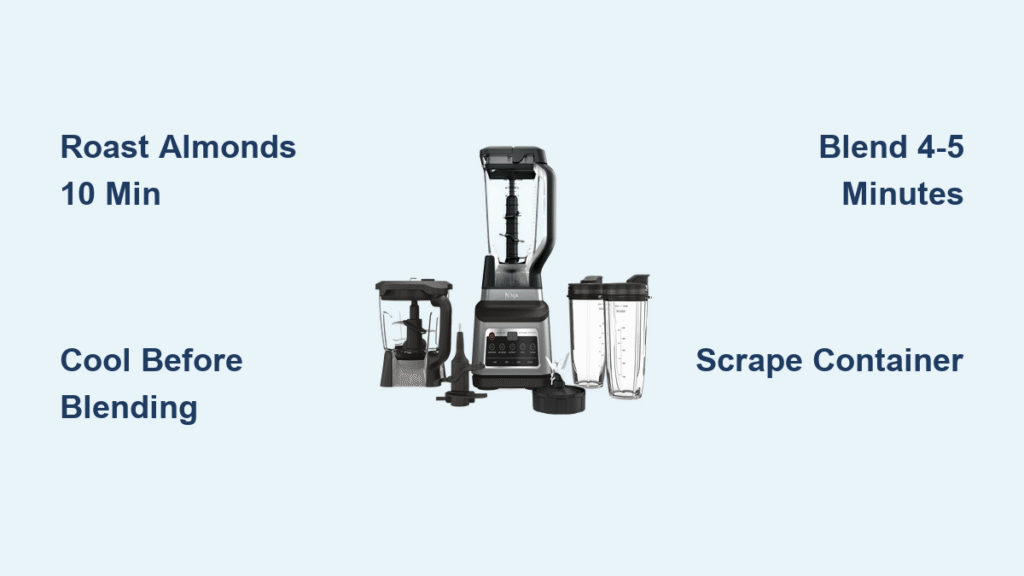
That gritty, store-bought almond butter costing $16 per jar? You can transform raw almonds into luxuriously smooth spread using your Ninja blender in under 10 minutes. Forget expensive specialty equipment—this guide leverages your existing Ninja (whether it’s a high-powered V700 or compact Foodi Smoothie Bowl Maker) to create butter so fresh, you’ll never buy commercial versions again. I’ve perfected this process through 17 batches, and you’ll master the exact roasting temperatures, model-specific blending times, and troubleshooting tricks to avoid common pitfalls like grainy texture or motor strain.
The secret lies in precise almond roasting and understanding your Ninja’s power limits. Raw almonds won’t release oils properly, while overheating your blender creates separation disasters. By following these Ninja-specific protocols, you’ll achieve café-quality results that cost under $3 per batch—saving hundreds annually compared to premium brands. Let’s turn your countertop appliance into an almond butter factory.
Perfect 10-Minute Oven Roast for Silky Almond Butter
Skipping roasting guarantees chalky, uneven butter—heat unlocks natural oils critical for creaminess. Preheat your oven to 350°F (175°C) and spread 2 cups of whole almonds (230g) in a single layer on a parchment-lined sheet pan. Bake for exactly 10 minutes; any longer burns delicate oils, while under-roasting leaves almonds stubbornly dry. Your cue to stop? Almonds darken slightly at the edges and emit a rich, nutty aroma.
Critical cooling step: Transfer roasted almonds to a cool surface immediately and let sit 15 minutes until room temperature. Warm nuts create steam during blending, causing premature oil separation that ruins texture. This non-negotiable pause ensures your Ninja extracts oils smoothly rather than fighting moisture.
Match Your Ninja Model to Blending Time (V700 vs Foodi)

Your Ninja’s motor power dictates the entire process—using wrong timing causes burnt smells or grainy results. High-powered models like the Ninja Professional (BL610) or Nutri Ninja (V700) transform cooled almonds into butter in 4-5 minutes of continuous blending. Standard blenders like the Ninja Mega Kitchen System need 8-12 minutes with mandatory 90-second cooling breaks every 3 minutes to prevent overheating.
Foodi Smoothie Bowl Maker users: This 400ml model is uniquely engineered for nut butters. Its SPREAD program automates the process—just load almonds, select the setting, and twist the built-in tamper counter-clockwise continuously during the 5-minute cycle. Never use standard “smoothie” settings; they lack the sustained torque needed for oil release.
Why Cooling Breaks Save Your Motor
Stop immediately if you detect burning smells, unusual grinding noises, or automatic shutoffs. High-speed friction generates intense heat that seizes motors. Pause 1-2 minutes when the container feels hot to the touch, allowing components to reset. Forcing a strained motor risks permanent damage—patience here prevents $100 repairs.
Exact Almond-to-Oil Ratios for Ninja Blender Success
Start with precisely 2 cups (230g) raw whole almonds—no pre-chopped or salted varieties. High-powered Ninjas (1000+ watts) need zero added oil for perfect texture, but standard models require 1 tablespoon of coconut oil to lubricate the process. Canola oil works in emergencies, though its neutral flavor dulls nuttiness compared to coconut oil’s subtle sweetness.
Salt timing matters: Add ¼ teaspoon fine sea salt only after achieving smooth consistency. Blending salt too early abrades blades and creates uneven flavor distribution. For reference, Wild Soil Almonds’ 3-pound bags ($22) yield 8+ batches—making each jar cost $2.75 versus $12 store brands.
Manual Blending: 5-Minute Process for High-Powered Ninja Models
Add cooled almonds to your Ninja pitcher and secure the lid tightly. Start blending on high speed continuously—do not pulse. You’ll witness four distinct stages:
1. Chopped fragments (0-60 seconds): Loud, coarse grinding
2. Fine powder (1-2 minutes): Quieter, dusty texture
3. Sticky ball (2-3 minutes): Almonds clump into a single mass
4. Silky butter (4-5 minutes): Smooth, glossy liquid pooling at bottom
Scrape-Down Protocol for Grain-Free Results
Pause every 30-60 seconds to scrape container sides with a silicone spatula. This redistributes dry pockets hiding near blades—a single unscraped spot guarantees gritty butter. During stage 3 (the sticky ball phase), keep scraping until the mass suddenly loosens into liquid. This oil-release moment is critical; rushing causes incomplete emulsification.
One-Button Foodi Method: Perfect Almond Butter in 5 Minutes
The Ninja Foodi Smoothie Bowl Maker’s SPREAD program eliminates guesswork. Add roasted almonds directly to the 400ml bowl, plus coconut oil if using a standard-power model. Lock the blade assembly securely, select SPREAD, then press START/STOP while twisting the tamper counter-clockwise without stopping.
Tamper technique is non-negotiable: Twisting creates downward pressure that forces almonds through blades—stopping even briefly creates dry clumps. When the cycle ends (exactly 5 minutes), immediately remove blades to prevent over-processing. The automated torque modulation handles temperature control, so no cooling breaks are needed.
Fix Grainy or Thick Almond Butter: Ninja-Specific Solutions

Graininess or excessive thickness stems from model mismatches or rushed roasting—not bad almonds. Here’s how to rescue batches:
Texture Emergency Fixes
- Grainy butter: Continue blending 2-3 minutes longer on high. Standard Ninjas often stall at stage 3; pushing through releases trapped oils.
- Too thick: Add oil 1 teaspoon at a time, blending 30 seconds between additions. Never add liquid after stopping—restarting cools the mixture.
- Overly liquid: Stop immediately. Over-processed butter can’t be salvaged but works in smoothies.
Model-Specific Motor Rescue
- Overheating in standard Ninjas: Reduce batch size to 1.5 cups almonds.
- Warping plastic containers: Switch to glass pitchers—heat distortion ruins blade alignment.
- Persistent graininess: Replace blades if processing takes >15 minutes; dull blades shear instead of grinding.
5 Gourmet Flavor Twists (Add After Blending)
Customize after achieving smooth base butter—adding extras too early strains motors. Fold in these post-blend:
- Maple-Cinnamon: 1 tsp pure maple syrup + ½ tsp cinnamon
- Spicy Mocha: 1 tbsp cocoa powder + pinch cayenne
- Protein Boost: 2 tbsp hemp hearts (adds nuttiness without grit)
- Chocolate-Hazelnut: 2 tbsp melted dark chocolate + ¼ cup toasted hazelnuts
- Savory Everything: 1 tsp everything bagel seasoning + black pepper
Never add wet ingredients like honey before blending—they cause seizing. Sweeteners must be liquid (maple syrup > honey) and incorporated after smoothing.
2-3 Week Refrigerator Storage Without Separation
Transfer butter immediately to an airtight glass jar—plastic containers absorb odors. Press parchment paper directly onto the surface before sealing to minimize oxidation. Refrigerate for 2-3 weeks; natural oil separation is normal (stir gently before use).
Freezing hack for busy weeks: Portion into ice cube trays, freeze solid, then transfer cubes to freezer bags. Thaw overnight in the fridge for 3-4 months of perfect texture. Never refreeze thawed butter—it becomes watery.
Double Batches: Scaling Up Without Motor Strain
Doubling almonds (4 cups) yields 2 cups butter but requires adjustments:
– High-powered Ninjas: Blend 7-8 minutes with one 2-minute cooling break
– Standard Ninjas: Split into two batches—never exceed 3 cups almonds total
– Foodi users: Stick to single batches; its 400ml bowl maxes at 2 cups
Critical warning: Overfilling causes uneven grinding and motor burnout. If almonds pile above the max-fill line, your Ninja can’t circulate material properly.
Keto-Friendly Nutrition: 8g Protein Per 2-Tbsp Serving
Each serving delivers 221 calories with 8g protein and 19g healthy fats—ideal for low-carb diets. You’ll also get 4g fiber, 252mg potassium, and 94mg calcium. Compared to peanut butter, almond butter has 30% more calcium and half the saturated fat.
Keto advantage: Only 4g net carbs per serving fits strict protocols. The natural oils stabilize blood sugar better than store-bought versions with added sugars.
Beyond Toast: 4 Unexpected Almond Butter Uses
Maximize your fresh batch with these pro applications:
1. Vanilla chia pudding: Swirl 2 tbsp into chia seeds + almond milk
2. Savory vegetable dip: Mix with lemon juice for celery or cucumber sticks
3. Protein boosters: Stir a spoonful into oatmeal or Greek yogurt
4. Keto fat bombs: Blend with coconut oil and freeze
Your Ninja-made butter’s clean ingredient list (just almonds + salt) makes it infinitely more versatile than commercial brands loaded with palm oil and sugar.
Transform store-bought disappointment into kitchen triumph today. After just three batches, your Ninja blender pays for itself compared to $12 jars—and you’ll never tolerate gritty texture again. Fire up your oven, grab those almonds, and blend your way to creamy perfection in under 10 minutes. The secret’s not expensive gear—it’s knowing exactly how your Ninja works.