You’re staring at a rough concrete slab, wondering how that roaring machine transforms it into a smooth, polished surface. When sparks fly during floor preparation, it’s not magic—it’s precision engineering leveraging diamond abrasives against concrete. Understanding how a concrete grinder work reveals why this tool dominates surface prep for renovations, coatings, and polishing. Unlike sanders for wood, concrete grinders tackle one of Earth’s toughest building materials using industrial-grade abrasion. This guide cuts through the noise to explain the actual mechanics behind those spinning discs, so you can choose the right tool and avoid costly mistakes during your project.
Concrete grinders solve a fundamental problem: concrete’s extreme hardness (typically 20-40 MPa compressive strength) requires abrasives harder than steel. That’s where synthetic diamonds enter the equation—they’re embedded in metal or resin bonds on grinding discs to systematically wear down the surface. Without this technology, preparing concrete for epoxy coatings or polishing would take exponentially longer with inferior results. You’ll learn exactly how rotation speed, disc configuration, and dust control combine to shave microns of concrete with each pass—knowledge that prevents uneven finishes and equipment damage.
Diamond Tooling: Why Concrete Requires Industrial Abrasives
How Synthetic Diamonds Cut Through Concrete Aggregate
Concrete contains hard aggregates like granite and limestone that quickly destroy conventional abrasives. Concrete grinders work by mounting diamond-segmented discs where microscopic synthetic diamonds (0.1-1mm size) protrude from metal or resin bonds. As the disc spins, these diamonds fracture the concrete surface through micro-fracturing—chipping away tiny particles rather than “sanding” like wood. The bond material slowly wears to expose fresh diamonds, maintaining cutting efficiency. Harder concrete requires softer bonds (faster diamond exposure), while softer concrete needs harder bonds (prolonged diamond retention).
Planetary vs. Rotary Grinding Systems Compared
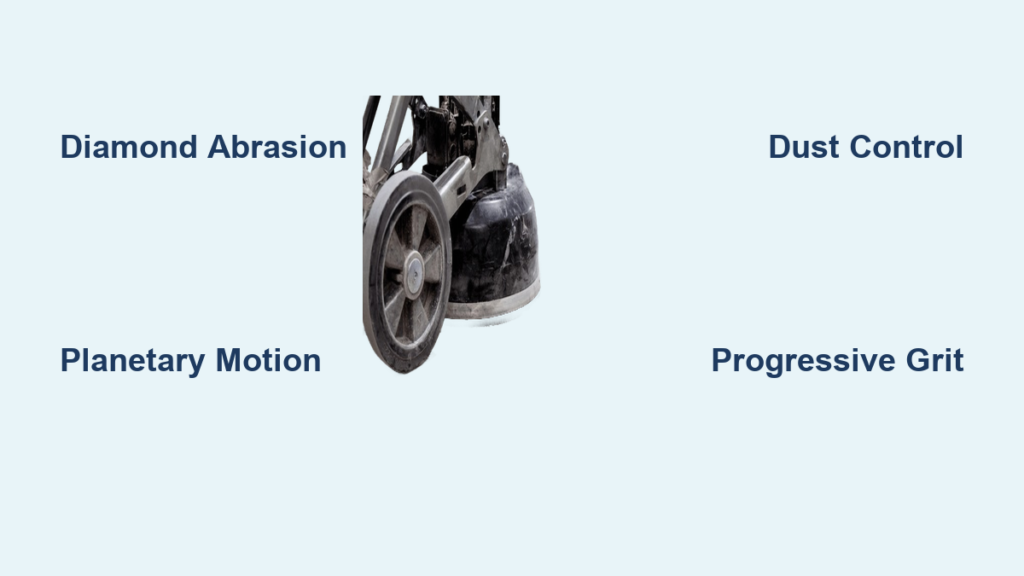
Handheld angle grinders use simple rotary motion—single-direction disc spin creating aggressive, uneven cuts suitable only for light scuffing. Real concrete grinder work happens with planetary systems: multiple satellite discs orbit a central axis while spinning individually. This dual-motion (typically 1,200-1,800 RPM orbital speed) eliminates swirl marks and ensures even wear across the entire surface. Walk-behind planetary grinders cover 500-2,000 sq ft/hour versus 50-100 sq ft/hour for rotary tools, making them essential for commercial projects. The orbital pattern also reduces operator vibration by 60-70% compared to standard angle grinders.
Dust Management: Why Vacuum Systems Are Non-Negotiable
OSHA Compliance and Health Risks of Silica Dust
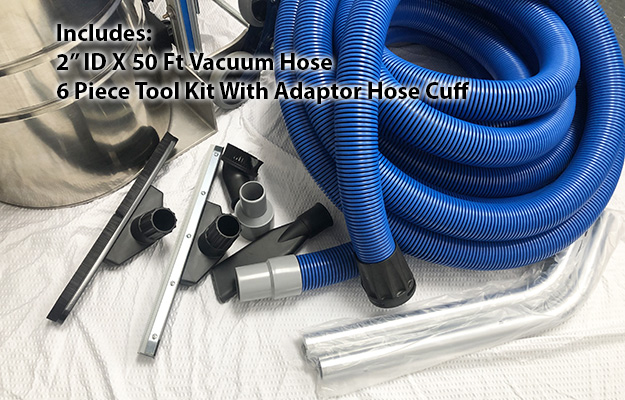
Concrete dust contains crystalline silica—a known carcinogen causing silicosis with just short-term exposure. When how does a concrete grinder work involves dry grinding, it produces 150+ microns of airborne silica per sq ft. OSHA mandates vacuum systems capturing 99% of particles below 10 microns (HEPA filtration). Without this, a single 10×10 ft room generates enough silica to exceed legal limits in under 5 minutes. Always verify your grinder’s vacuum port connects to a construction-rated HEPA vacuum (≥130 CFM airflow), not a shop vac.
Water vs. Vacuum Grinding: Critical Tradeoffs
Wet grinding suppresses dust via water injection but creates slippery slurry and delays coating adhesion. Dry grinding with HEPA vacuums is preferred for epoxy applications since it leaves a clean, dry surface ready for priming. However, wet systems extend diamond life by 25% by cooling the grinding zone and preventing “glazing” (when concrete paste clogs diamond segments). For interior work, dry grinding is mandatory—water damage risks outweigh minor tooling savings. Always inspect vacuum hoses for cracks before starting; a single leak compromises 80% of filtration efficiency.
Operational Techniques That Prevent Costly Surface Damage
Progressive Grit Sequencing for Flawless Finishes
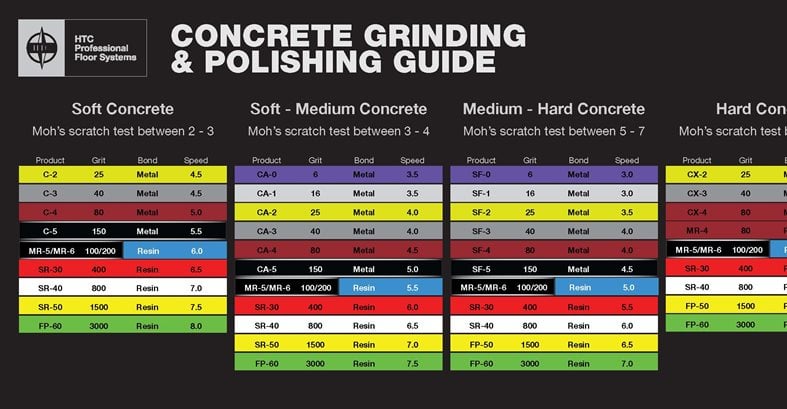
Skipping grit sequences is the #1 cause of “orange peel” texture in polished concrete. How a concrete grinder work effectively requires systematic progression:
1. Start with 6-12 grit metal-bonded discs to remove coatings/laitance (1-2 passes)
2. Move to 20-40 grit resin bonds for leveling (2-3 passes)
3. Finish with 80-3000+ grit for polishing (4-6 passes)
Each jump should increase grit by ≤50% (e.g., 30 → 50, not 30 → 100). Rushing stages leaves visible scratches requiring rework. For coating prep, stop at 80-150 grit—higher polishes reduce mechanical adhesion. Always overlap passes by 50% and maintain 2-3 mph travel speed.
Weight Distribution and Tilt Angle Mistakes to Avoid
Leaning heavily on walk-behind grinders causes “dish grinding”—dipping edges while center remains high. Maintain even pressure: let the machine’s weight (typically 150-400 lbs) do the work. For handheld units, keep the disc at 5-10° tilt to the surface; perpendicular angles cause chatter marks. Never force the grinder forward—concrete removal happens vertically, not horizontally. If you see consistent sparks on one side, the disc is warped or bearings are failing.
Maintenance Protocols That Extend Grinder Lifespan
Daily Checks Prevent Catastrophic Failures
Before each use, inspect these critical components:
– Flanges: Must be clean, flat, and free of concrete buildup (warping causes disc wobble)
– Spindle threads: Lubricate with anti-seize compound to prevent seized discs
– Vacuum seals: Replace cracked O-rings immediately (dust ingress destroys motors)
– Diamond segments: Tap segments with screwdriver—if they rattle, the bond is failing
Ignoring these causes 70% of premature tool failures. Always remove discs after use to prevent moisture corrosion on the spindle.
Flushing Water Systems After Wet Grinding
Residual slurry in water lines crystallizes overnight, clogging nozzles and pumps. After wet grinding, run clean water through the system for 2 full minutes. For hard water areas, add descaling solution monthly. Clogged nozzles create uneven cooling, causing localized overheating that cracks diamond segments. This single step extends pump life by 300% and prevents $200+ repair bills.
When to Choose Walk-Behind vs. Handheld Grinders
Square Footage and Project Complexity Deciders
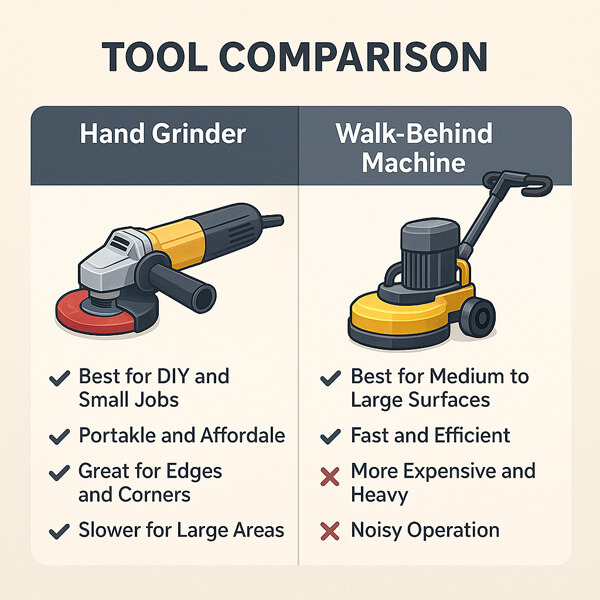
Handheld angle grinders (4.5-7 inch) work only for small touch-ups (<100 sq ft) like patching edges. Their single-disc rotation creates inconsistent cuts unsuitable for full-floor prep. Walk-behind planetary grinders (10-30 inch) are mandatory for:
– Areas over 200 sq ft (time savings exceed 400%)
– Leveling height variations >1/8 inch
– Achieving uniform profiles for epoxy coatings
– Commercial projects requiring SSPC-SP13/NACE No. 6 standards
Power Requirements and Electrical Safety
Walk-behind grinders demand 240V circuits (15-50 amps) versus standard 120V for handhelds. Using undersized extension cords causes voltage drop, overheating motors. Calculate minimum wire gauge:
– 15-amp tools: 14-gauge cord (max 50 ft)
– 30-amp tools: 10-gauge cord (max 75 ft)
– 50-amp tools: 6-gauge cord (max 100 ft)
Always test GFCI outlets before starting—concrete grinding near moisture risks electrocution.
Final Note: Concrete grinders transform surfaces through diamond abrasion physics—not brute force. Mastering how a concrete grinder work means respecting the diamond grit progression sequence, maintaining dust control systems, and matching machine size to your project scale. For coating prep, stop grinding when the surface resembles fine sandpaper (80-150 grit); higher polishes sacrifice adhesion. Always replace worn diamond segments before they expose the steel core—this prevents metal contamination that ruins epoxy finishes. Next, explore “concrete grinder disc types” to select bonds matching your slab’s hardness, or study “SSPC-SP13 surface profile standards” for professional coating results. Proper technique turns this aggressive tool into a precision instrument, saving days of rework and thousands in material waste.