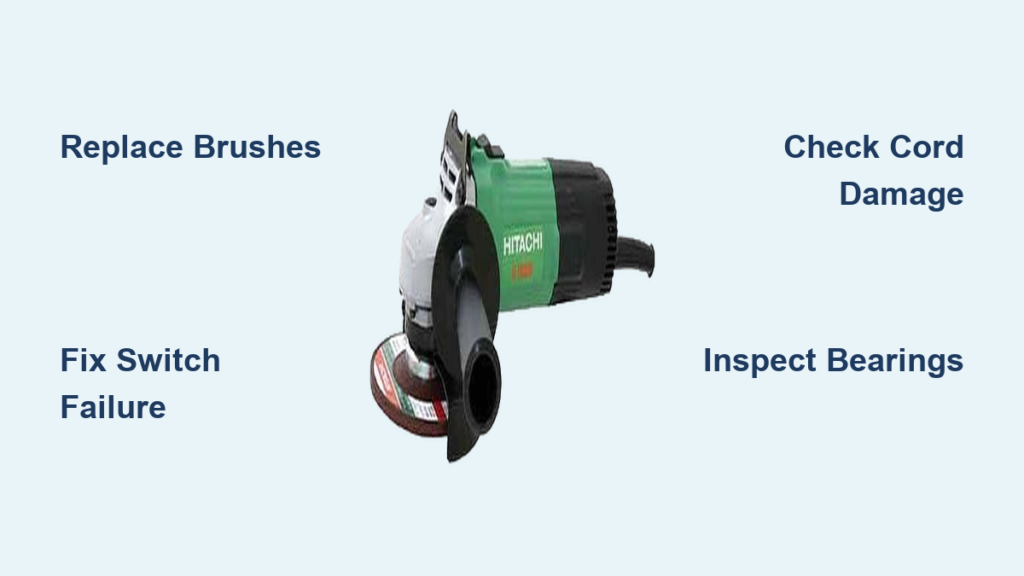
Nothing disrupts your workflow like a Hitachi angle grinder that suddenly stops working mid-project. Whether you’re a professional contractor or weekend DIYer, knowing how to diagnose and repair common Hitachi grinder problems saves costly downtime and unnecessary tool replacement. This guide delivers precise, actionable repair procedures you can complete in your workshop with basic tools. You’ll learn to identify symptoms, implement fixes for the most frequent failures, and extend your grinder’s lifespan through proper maintenance.
Before attempting any repair, unplug the grinder and wear safety glasses and work gloves. Angle grinders operate at 10,000+ RPM, and even disconnected tools can cause serious injury if proper precautions aren’t taken. Never bypass safety features or operate a damaged grinder.
Why Your Hitachi Grinder Won’t Start and How to Fix It
When your Hitachi grinder refuses to power up, systematic diagnosis prevents wasted effort on unnecessary repairs. Begin with the simplest possibilities that account for 70% of starting failures before progressing to complex motor issues.
Check your electrical source first by testing the outlet with another device. If the outlet works, inspect the power cord for visible damage, fraying, or kinks near the plug or handle. Flex the cord while pressing the trigger—if the grinder sputters to life during movement, internal wire breakage requires cord replacement. For corded models, replace damaged cords immediately rather than attempting splices that compromise safety.
If the cord appears intact, test the switch by removing the handle cover (typically secured by two screws) and inspecting internal connections. Look for loose wires, corroded terminals, or burnt contacts. Use a multimeter to test continuity through the switch circuit—no continuity when engaged confirms switch failure. Pro tip: Spray electrical contact cleaner into the switch mechanism before replacing; this often resolves intermittent operation caused by dust buildup.
Brush inspection follows switch testing. Worn brushes create poor electrical contact with the motor commutator, causing starting failures. Remove both brush holder caps (usually marked with arrows) and examine the carbon blocks. Replace brushes under 1/4 inch in length or showing uneven wear patterns. Critical warning: Always replace both brushes simultaneously—even if only one appears worn—to prevent uneven commutator wear.
Replace Worn Motor Brushes in 30 Minutes

Motor brush replacement resolves 60% of Hitachi grinder electrical issues and requires only basic tools. This repair restores power delivery to the motor and eliminates excessive sparking that damages commutators.
Begin by unplugging the tool and removing the grinding disc. Locate the brush holder caps on either side of the motor housing—they’re typically marked with directional arrows. Unscrew these caps counterclockwise using a flat-blade screwdriver. With caps removed, the brush assemblies pull out easily. Note each brush’s orientation before removal, as improper installation causes immediate failure.
Measure the existing brushes against new replacements—Hitachi brushes should maintain at least 1/4 inch length for proper contact. Inspect the commutator surface through the brush openings: it should appear smooth and copper-colored. Discoloration, pitting, or scoring requires commutator cleaning or professional resurfacing. Expert note: Light brown discoloration is normal; dark blue or black indicates overheating that may require armature replacement.
Install new brushes by aligning them in their original orientation and pushing into the holder until the spring seats properly. Reinstall both brush caps, tightening them snugly but avoiding overtightening that cracks plastic housings. Test operation briefly with the disc removed—the motor should run smoothly without excessive vibration or grinding sounds.
Fix Switch and Electrical Failures Without Special Tools
The paddle switch in Hitachi grinders fails from repeated use, causing intermittent operation that frustrates even experienced users. Replacement costs under $15 and takes less than 20 minutes with basic tools.
Access the switch by removing the handle cover and documenting wire connections with photos before disconnecting anything. The switch typically has two or three wires connected via spade terminals. Release wire retainers and pull connectors free. Note the switch mounting method—some are clipped while others use small screws. Take the old switch to a hardware store to ensure exact replacement match.
Install the new switch by reversing removal steps. Verify wires connect to correct terminals matching your photos. Test switch operation before reassembling the handle—the tool should start smoothly and stop immediately when released. Pro tip: Apply dielectric grease to terminals before reconnection to prevent future corrosion.
For 7-inch Hitachi grinders with capacitor start systems, inspect the start capacitor if the motor hums but won’t start. A swollen or leaking capacitor requires immediate replacement. Discharge the capacitor safely by shorting its terminals with an insulated screwdriver before handling. Critical warning: Never bypass a failed capacitor—this causes immediate motor burnout.
Repair Spindle Bearings Before Catastrophic Failure
Worn spindle bearings create dangerous disc wobble that ruins grinding performance and risks injury. Diagnose bearing issues by grasping the spindle flange and attempting to rock it side-to-side—any detectable movement indicates bearing wear requiring immediate attention.
Bearing replacement requires a bearing puller and press, but prevents complete spindle seizure. Begin by removing the spindle nut, outer flange, and retaining clips. The spindle slides out of the housing, exposing the bearings. Press old bearings off using a bearing puller or appropriate socket setup.
Clean the spindle shaft thoroughly and inspect for scoring—if the bearing surface shows significant wear, spindle replacement is necessary. Press new bearings onto the spindle, ensuring full seating against shoulders. Use only high-quality bearings matching Hitachi specifications—cheap replacements fail quickly under grinder loads. Expert note: Apply precisely 5-7 drops of high-temperature bearing grease during reassembly; excess attracts debris and causes overheating.
Troubleshoot Armature and Field Coil Problems

Armature failures cause excessive sparking, power loss, and burning smells during operation. Visual inspection through brush openings reveals commutator condition—dark discoloration, pitting, or raised segments between bars indicate armature problems requiring professional attention.
Field coil failures typically cause complete motor failure with no sound when triggering. Test field coils by disconnecting from the circuit and checking continuity with a multimeter. Open circuits (infinite resistance) or shorted circuits (near-zero resistance) confirm coil failure. Critical warning: Field coils cannot be repaired effectively and require complete motor replacement.
Commutator resurfacing extends armature life when windings remain healthy. A qualified repair shop machines the commutator smooth and undercuts insulation between bars to proper depth. This restores brush contact and reduces sparking significantly. Pro tip: If your grinder produces blue sparks (normal) rather than white sparks (problematic), commutator resurfacing may save expensive motor replacement.
Prevent Future Failures with Proper Maintenance
Regular maintenance extends your Hitachi grinder’s service life by preventing 80% of common failures. Spend just 5 minutes after each use cleaning vents and inspecting critical components.
Clean the tool after each use by blowing compressed air through motor housing vents and around brush areas. Accumulated dust insulates motor components, causing overheating and winding failure. Remove material buildup from the spindle flange that prevents proper disc seating.
Inspect brushes every 10-15 hours of operation—replace in pairs before they wear completely. Check commutator condition each time you access brushes; light discoloration is normal but heavy burning requires attention. Lubricate spindle bearings every 50-100 hours with specified high-temperature grease.
Store your grinder in a dry location protected from dust and temperature extremes. Never store with a grinding disc mounted—disc material degrades and creates dangerous imbalance during subsequent use. Expert note: Wrap the power cord loosely around the handle rather than kinking it, which causes internal wire breakage over time.
When Professional Repair Beats DIY Attempts
Some Hitachi grinder repairs exceed DIY practicality. Recognize these situations to avoid wasted time and ensure safe operation.
Professional repair makes sense when the estimate is under 50% of replacement cost. Hitachi motor assemblies often cost nearly as much as new tools, making replacement more economical than major component repair. Safety-critical failures—including housing cracks, damaged cord insulation, or compromised guards—always require professional attention due to electrocution risks.
If your grinder has sentimental value, unique specifications, or represents specialized business equipment, professional rebuilding may justify the investment. Authorized Hitachi service centers use OEM parts and proper procedures ensuring reliable long-term operation. Critical warning: Never attempt armature rewinding or field coil replacement as a DIY project—improper insulation causes immediate motor failure and fire hazards.
Quick Reference: The most common Hitachi grinder repairs—brush replacement, switch service, and cord replacement—require basic tools and 30-60 minutes. Bearing and armature repairs demand specialized equipment that often makes professional service more practical. Regular maintenance prevents 80% of failures and extends tool life significantly. When in doubt about electrical repairs, consult a professional—your safety is worth more than the cost of proper service.