Every time you fire up a stationary grinder, you’re working with a tool that stores tremendous kinetic energy—enough to cause catastrophic injuries if safety protocols aren’t strictly followed. Statistics show that improper stationary grinder safety practices lead to thousands of workplace injuries annually, from devastating wheel explosions to severe lacerations and entanglement accidents. These aren’t minor risks; they’re life-altering hazards that demand your full attention every single time you approach the machine. This guide delivers the precise safety measures you need to implement immediately to protect yourself and your coworkers from preventable grinding disasters, covering everything from proper PPE selection to critical pre-operation checks that could save your life.
Mandatory PPE for Stationary Grinder Operations

Your personal protective equipment isn’t optional—it’s your last line of defense when everything else fails. Skipping even one piece of required safety gear transforms routine grinding into a high-risk activity where a single spark or fragment can cause permanent damage. Taking just two minutes to properly equip yourself creates an essential barrier between you and the high-velocity hazards inherent in stationary grinder operations.
Eye Protection That Actually Works
Safety glasses meeting ANSI Z87.1 standards with side shields form your absolute minimum eye protection, creating a critical barrier against debris that flies at dangerous speeds during grinding. However, safety glasses alone won’t stop a catastrophic wheel explosion—when your grinder lacks an integral eye shield, you must wear a full face shield over your safety glasses. This layered protection strategy ensures you maintain eye safety even if your face shield gets compromised or needs temporary removal. Never operate a stationary grinder without eye protection, even for “quick” tasks—the time saved isn’t worth losing your vision to a single metal fragment traveling at 10,000 RPM.
Complete Body Protection System
Stationary grinders generate noise levels exceeding 85 decibels that cause permanent hearing damage over time, making industrial-grade hearing protection non-negotiable for every grinding session. Choose between properly inserted earplugs or well-fitted earmuffs, but never skip this essential protection that preserves your hearing for decades to come. Your feet require equally serious protection—reinforced toe cap shoes shield against dropped workpieces, broken wheel fragments, and accidental contact that could crush or penetrate regular footwear. Never wear sandals, sneakers, or open-toed shoes near a stationary grinder—the risk of foot injury from falling debris or wheel fragments is simply too high.
Preventing Catastrophic Wheel Failures
A grinding wheel spinning at high RPM contains enough stored energy to cause fatal injuries when it fails, making wheel safety the most critical aspect of stationary grinder safety. Understanding wheel failure mechanics transforms abstract safety rules into concrete survival practices that you’ll follow without question.
Avoiding Deadly Mounting Mistakes
Improper wheel installation creates the most dangerous failure conditions—wheels mounted with incompatible flanges, insufficient torque, or dirty mounting surfaces develop dangerous imbalances that stress wheel structure beyond safe limits. Before mounting any wheel, always verify flange compatibility, clean all mounting surfaces, and apply precise torque using calibrated tools. If you’re uncertain about any aspect of wheel mounting, disassemble and restart the process—taking an extra ten minutes beats the consequences of a wheel exploding in your face.
Spotting Dangerous Wheel Damage Before It’s Too Late
Conduct thorough visual inspections before each use, checking for cracks, chips, surface damage, and abnormal wear patterns that indicate compromised structural integrity. Any visible crack, no matter how small, means immediate wheel destruction and replacement—don’t risk catastrophic failure for the sake of saving a few dollars. Listen for abnormal sounds during operation; a properly functioning wheel produces consistent grinding noise, while internal damage manifests as vibration, wobble, or unusual sounds. When you hear or feel anything abnormal, stop immediately and inspect—better to lose fifteen minutes than risk wheel failure.
Material Restrictions That Prevent Fires and Explosions
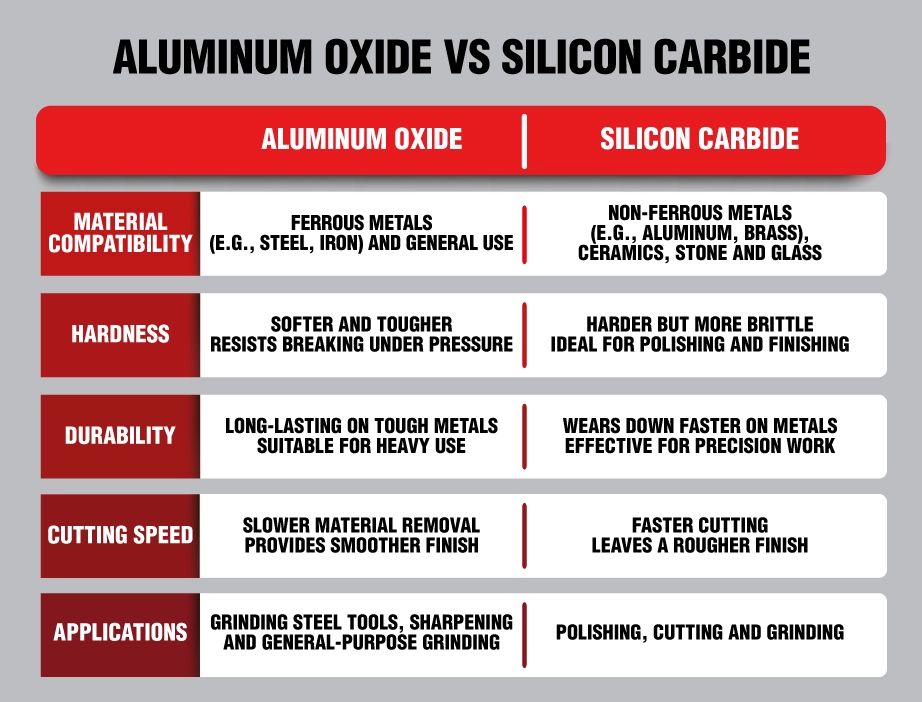
Stationary grinders are engineered specifically for ferrous metals, and grinding inappropriate materials introduces hazards that proper guarding and PPE cannot fully mitigate. Knowing exactly which materials to avoid protects you from fire, explosion, and catastrophic equipment failure.
Why Non-Ferrous Metals Are Dangerous
Brass, aluminum, and copper create serious fire hazards when ground because the heat generated by the abrasive wheel causes these metals to ignite spontaneously in some cases. Beyond fire risks, these materials load the grinding wheel surface with molten deposits, reducing effectiveness while creating dangerous wheel imbalance conditions. Never attempt non-ferrous metal grinding on standard stationary grinders—the convenience isn’t worth risking fire or wheel explosion.
Combustible Materials That Could Destroy Your Workshop
Plastics pose combustion hazards when ground, melting onto wheel surfaces and creating dangerous buildup that throws molten material toward you. Wood materials present the most severe hazards—accumulated wood dust combined with hot sparks creates fire and explosion conditions that can engulf your entire shop. Additionally, wood pieces catch in grinding wheels and transform into high-velocity projectiles. Never grind wood, plastics, or other combustible materials on stationary grinders—dedicated equipment with appropriate safety systems is required for these materials.
Machine Guarding That Actually Protects You

Machine guards provide passive protection against wheel fragmentation and debris ejection, reducing your exposure to the most dangerous grinder hazards without requiring constant operator attention. Proper guard setup is a fundamental stationary grinder safety requirement that must be verified before every operation.
Side Guard Specifications That Save Lives
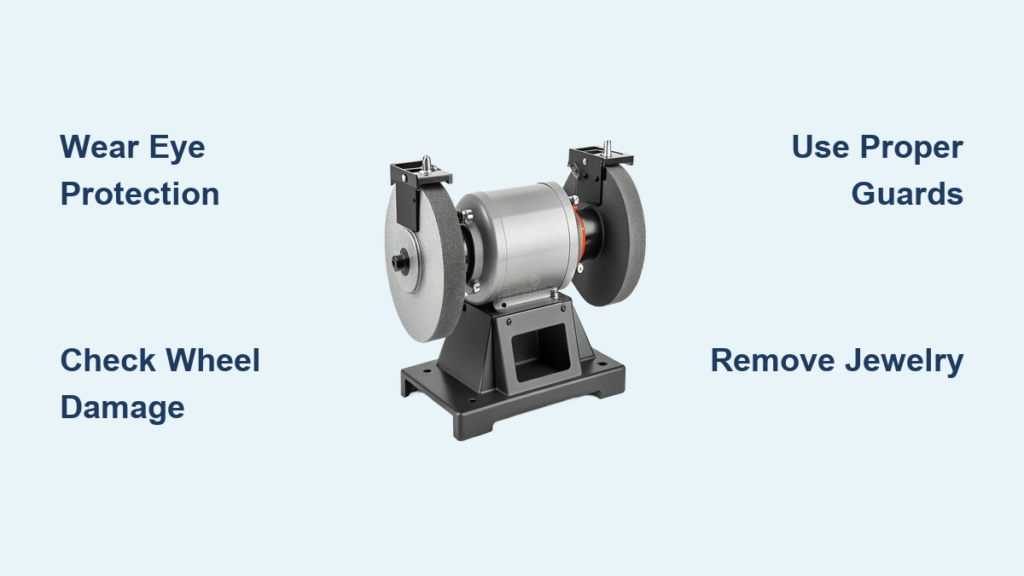
Your side guard must cover at least 75% of the wheel diameter and protect the spindle assembly, wheel retention nut, and mounting flange. Guards that expose more wheel surface create unacceptable risk levels during wheel failure events. Before each use, check guard adjustment and mounting hardware tightness—vibration from regular operation gradually loosens components. Damaged or deformed guards must be replaced immediately; compromised guards provide inadequate protection and may fail precisely when you need them most.
Work Rest and Tongue Guard Precision Settings
The work rest must maintain maximum clearance of 1/8-inch from the grinding wheel surface at all times—excessive clearance allows workpieces to drop into the gap, creating dangerous catch points that snatch workpieces from your grip. The tongue guard must be positioned within 1/4-inch of the wheel surface to intercept material thrown from the grinding zone while allowing adequate workspace. Verify both measurements before every operation—these small clearances make the difference between safe grinding and catastrophic hand contact.
Wheel Installation Protocols Every Operator Must Know
Proper wheel installation and maintenance protect against some of the most dangerous grinder hazards, including explosive wheel failure. These procedures require specialized knowledge that every operator should understand, even if performed by designated personnel.
RPM Compatibility Verification That Prevents Explosions
Always verify RPM compatibility by checking both the grinder motor nameplate and the wheel’s marked maximum operating speed—installing a wheel with an RPM rating lower than your grinder’s motor speed creates an extremely dangerous condition where rotational forces exceed wheel design limits. When compatibility questions arise, always select the safer wheel with the higher RPM rating. Under no circumstances should any wheel be operated at speeds exceeding its marked rating—this represents one of the most preventable causes of wheel failure accidents.
Ring Testing Procedures That Catch Hidden Damage
Suspend the wheel by its arbor hole and tap it gently with a non-metallic object near the mounting surface—a properly functioning wheel produces a clear, ringing tone indicating intact internal structure. Dull, dead, or cracked sounds signal internal damage requiring immediate wheel replacement. Perform ring testing on all new wheels before first use, even when received in apparently undamaged packaging—internal shipping damage can occur without visible external signs.
Pre-Operation Safety Checklist You Must Complete
Conducting a systematic safety check before each grinding operation verifies that all protective systems are functional and correctly configured. This five-minute routine catches problems before they endanger your safety and should become as automatic as breathing.
- Verify all machine guards are in place, properly adjusted (work rest ≤1/8-inch, tongue guard ≤1/4-inch), and securely mounted
- Perform ring test and visual inspection of grinding wheel for any damage
- Confirm appropriate PPE is available and in good condition
- Remove all jewelry, secure long hair, and check clothing for loose elements
- Verify workpiece is appropriate for grinding and fixturing is ready
Safe Operation Techniques That Prevent Contact Injuries
Maintaining safe operational practices throughout each grinding task protects against the gradual erosion of safety margins that occurs when operators become complacent. These practices must become automatic habits you follow consistently.
Always stand positioned to the side of the grinding zone rather than directly in front, reducing your exposure to potential wheel fragments in case of failure. Apply consistent workpiece pressure without excessive force that could overload the wheel. Use work rests and fixtures to support workpieces rather than hand-holding small items—never grind workpieces smaller than three inches without proper fixturing. Allow wheels to come to a complete stop before making adjustments, and never leave a running grinder unattended.
Preventing Fatal Entanglement Accidents
The rotating components of stationary grinders create severe entanglement hazards that can pull operators into the machine with potentially fatal results. Preventing entanglement requires careful attention to personal preparation that eliminates opportunities for contact with rotating parts.
Remove all jewelry before operating grinding equipment—rings, bracelets, and necklaces can catch in rotating spindles, pulling you into the machine. Secure long hair completely away from your face and neck, as it presents an insidious hazard that can become entangled without immediate recognition. Keep loose clothing, sleeves, and cuffs secured away from all rotating elements. During operation, maintain awareness of your body position relative to rotating parts and never reach across operating wheels.
Mastering stationary grinder safety requires consistent attention to protective equipment, hazard awareness, material restrictions, machine guarding, and operational practices. Each element contributes to a comprehensive safety posture that protects you from the serious hazards these powerful tools present. Implement these guidelines in your workshop without exception, make safety checks automatic habits, and never compromise on protective measures—your future self will thank you for the discipline you maintain today. When it comes to stationary grinder safety, there are no second chances with catastrophic wheel failures, so treat every operation with the respect it demands.