That frustrating moment when your carefully brewed coffee tastes flat or bitter despite using premium beans? More often than not, the culprit isn’t your technique or beans—it’s your grinder. Freshly ground coffee unlocks volatile aromatic compounds that vanish within minutes of grinding, which is why baristas insist on grinding beans seconds before brewing. Yet simply owning any grinder won’t guarantee quality; the specific coffee grinder types you choose determines whether you’ll experience balanced extraction or a muddy flavor profile. With options ranging from $10 blade models to professional-grade burr systems, understanding how each type impacts your daily cup is essential for transforming your home brewing from hit-or-miss to consistently exceptional.
The grinding process fundamentally shapes your coffee’s chemical extraction. When water interacts with coffee particles, it dissolves soluble compounds that create flavor—but only if the particles are uniform in size. Inconsistent grounds create a dual extraction problem: fine particles over-extract (creating bitterness) while coarse particles under-extract (yielding sourness). This is why coffee grinder types matter more than most beginners realize—they’re not just appliances but precision instruments controlling your coffee’s very chemistry. This guide cuts through marketing hype to show exactly which grinder delivers results for your specific brewing method, budget, and morning routine.
Why Your $10 Blade Grinder Sabotages Flavor Consistency
Blade grinders chop beans with a spinning propeller rather than grinding them, creating a random mix of fine powder and chunky fragments in every batch. This inconsistency directly causes the bitter-sour flavor cocktail that plagues many home brewers. While acceptable for drip coffee where extraction time compensates for particle variation, blade grinders fail spectacularly with espresso or pour-over methods requiring precise particle uniformity. The heat generated from friction during operation may also degrade delicate coffee aromatics before they ever reach your cup.
When blade grinders actually work for your routine:
– You primarily brew automatic drip coffee
– You’re testing fresh grinding on a tight budget
– You brew coffee infrequently (once weekly or less)
– Flavor nuance matters less than simplicity to you
Flat vs. Conical Burr Grinders: The Espresso vs. Pour-Over Showdown
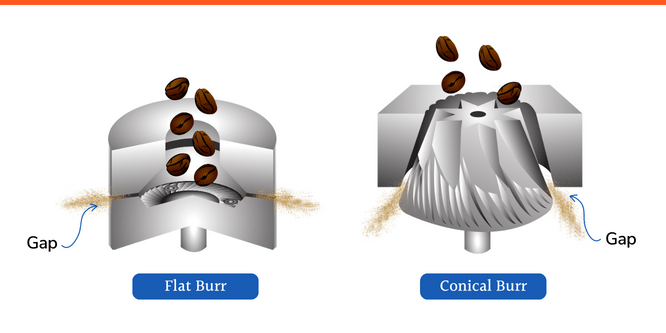
Burr grinders solve the consistency problem by crushing beans between two serrated plates rather than chopping them. This creates remarkably uniform particles essential for balanced extraction—but not all burr grinders perform equally across brewing methods.
Why Flat Burrs Dominate Professional Espresso Machines
Flat burr grinders feature parallel plates that produce the most uniform particle distribution of any coffee grinder types, making them the undisputed choice for espresso. The even particle size ensures water encounters consistent resistance through the puck, preventing channeling that creates uneven extraction. If you’re serious about home espresso, flat burrs deliver the precision needed—but prepare for louder operation and increased static causing grounds to cling to the hopper. Top models like the Baratza Virtuoso+ ($200) justify their price through years of reliable espresso-quality grinding.
How Conical Burrs Quietly Win for French Press and Pour-Over Lovers
Conical burr grinders use a cone-shaped burr inside a ring-shaped counterpart, operating at slower RPMs that generate less heat and noise. While producing a slightly bimodal particle distribution (some fine, some coarse), this variation actually benefits longer-steep methods like French press where extraction time compensates. The quieter operation makes conical burrs ideal for early risers who don’t want to wake the household, and models like the Baratza Encore ($130) deliver exceptional versatility across most brewing methods at accessible price points.
Manual Grinder Types: Your Secret Weapon for Travel and Tiny Kitchens
Manual grinders transform hand-cranking into precision grinding through quality burr mechanisms that rival electric counterparts. The STARESSO Discovery Grinder ($80) exemplifies this category—its compact design fits in backpacks yet handles everything from espresso-fine to French press-coarse grinds. Unlike electric models requiring counter space and outlets, manual grinders work anywhere: camping trips, hotel rooms, or office kitchens where power access is limited.
When Hand Grinding Becomes Ritual Rather Than Chore
The physical effort required makes manual grinders impractical for households brewing multiple daily pots, but for solo drinkers or occasional use, they offer surprising advantages:
– Zero noise pollution for early morning brewing
– Complete portability without electrical constraints
– Enhanced flavor preservation from minimal heat generation
– Mindful preparation that connects you to the coffee process
Electric Burr Grinder Types: The Daily Convenience You’ll Actually Use
Electric burr grinders deliver push-button precision that makes consistent grinding effortless—a game-changer for busy households. The STARESSO Discovery II ($150) demonstrates how modern electric grinders combine programmable settings with minimal cleanup. Set your preferred grind once, and the machine reproduces it perfectly every time—no timing experiments or visual assessments needed.
Countertop Real Estate: Calculating Your Electric Grinder Space Needs
Before purchasing, measure your available space—quality electric burr grinders typically require 8″ x 8″ of counter space plus clearance for bean hoppers. If kitchen real estate is limited, consider models with removable components that store vertically (like the Fellow Ode). Remember that electric grinders lose functionality during power outages, making them less ideal as primary grinders in areas with unreliable electricity.
Match Coffee Grinder Types to Your Brewing Method Like a Pro

Your brewing method should dictate your grinder choice more than budget or aesthetics. Espresso requires the most precise grind consistency of any common method, demanding flat burr grinders that produce particles uniformly sized within microns. French press needs coarse, even particles that won’t slip through the mesh filter—conical burrs excel here with their slightly varied but still consistent output. Pour-over methods like V60 or Chemex need medium-fine grinds where both flat and conical burrs perform well, though flat burrs provide marginally better consistency for competitive brewers.
Critical mismatch to avoid: Using a blade grinder for espresso. The inconsistent particles create extraction chaos under pressure, yielding either sour shots or bitter sludge—never the balanced, syrupy espresso you’re chasing.
Coffee Grinder Maintenance: Prevent Off-Flavors in 5 Minutes Weekly
Old coffee oils oxidize on grinder surfaces, creating rancid flavors that ruin even the freshest beans. Most coffee enthusiasts overlook this critical maintenance step, unknowingly poisoning their daily brew. The solution takes less than five minutes weekly:
- After each use: Brush grounds from burrs and hopper with a dedicated grinder brush
- Weekly: Run 1-2 tablespoons of uncooked rice through the grinder (removes oils)
- Monthly: Disassemble removable parts (following manufacturer instructions) and wipe with dry cloth
- Annually: Remove burrs (if possible) and clean crevices with soft brush
Warning: Never use water on electric grinder components unless explicitly permitted by the manufacturer—moisture can damage motors and create electrical hazards.
Coffee Grinder Type Comparison: Blade vs. Burr Cost vs. Quality Analysis

| Grinder Type | Price Range | Best For | Flavor Impact | Daily Time Cost |
|---|---|---|---|---|
| Blade | $10-$30 | Drip coffee beginners | Moderate inconsistency | 30 seconds |
| Flat Burr | $100-$300 | Espresso enthusiasts | High consistency | 45 seconds |
| Conical Burr | $80-$200 | Pour-over/French press | Excellent consistency | 40 seconds |
| Manual Burr | $20-$200 | Travelers/tiny kitchens | Great consistency | 2-4 minutes |
$10 Blade vs. $100 Burr: Is the Flavor Difference Worth It?
For casual drip coffee drinkers, a blade grinder provides noticeable improvement over pre-ground coffee at minimal cost. But if you brew pour-over, French press, or espresso regularly, the burr grinder’s consistent particle size delivers such significant flavor improvement that most enthusiasts consider it non-negotiable. The investment pays off in better extraction efficiency—you’ll use less coffee to achieve stronger flavor, partially offsetting the higher upfront cost.
Final Coffee Grinder Selection Checklist
Before purchasing, answer these questions to eliminate guesswork:
- What’s your primary brewing method? (Espresso requires flat burrs)
- How many cups do you brew daily? (More than 2 favors electric)
- Do you travel or have limited counter space? (Manual wins here)
- How sensitive are you to flavor nuances? (Burr grinders for discerning palates)
- What’s your realistic cleaning commitment? (Manual easiest, electric most complex)
The right coffee grinder types transform your brewing from mundane routine to daily ritual worth savoring. Whether you choose the affordability of a blade grinder, the precision of a flat burr, the versatility of conical burrs, or the portability of manual options, understanding how each type impacts extraction puts you in control of your coffee experience. Remember: no grinder makes bad beans great, but the right grinder absolutely makes good beans exceptional. Your perfect cup starts with the right grind—choose wisely and taste the difference from your very first brew.