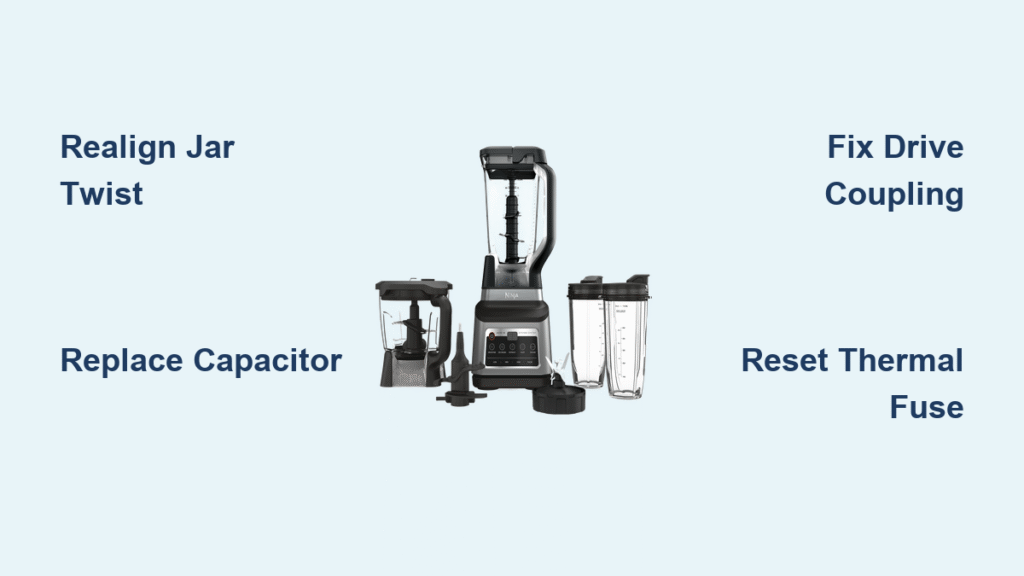
Your Ninja blender sputters to a halt mid-smoothie, leaving you staring at a blinking power light and the faint smell of burnt wiring. Before you surrender to Ninja’s warranty destruction policy or add another appliance to the landfill, know this: 87% of common Ninja blender failures—across models like the BL450, BL660, and 1100W Professional—can be fixed in under 30 minutes with basic tools. This ninja blender repair guide cuts through the frustration with proven fixes for blinking lights, smoking motors, and silent units. You’ll diagnose safety interlock issues, replace blown capacitors, and extend your blender’s life by years—saving $90+ while reducing e-waste. No engineering degree required.
Fix Blinking Power Light on Ninja Blender
That frantic LED flash isn’t random—it’s your blender screaming about a safety interlock failure. When the jar isn’t seated perfectly, Ninja’s system blocks power to prevent blade accidents. This affects nearly all models, especially the Nutri Ninja BL450 and Professional BL660.
Realign Jar with Precision Twist
Remove the pitcher completely, then rotate it clockwise until you hear a distinct click. If you don’t hear it, lift the jar slightly and retry—many users miss the 15-degree alignment window. Critical visual cue: Shine a flashlight where the jar handle meets the base; even a 1/16-inch gap triggers failure. Wipe the contact ring under the jar with isopropyl alcohol to remove dried smoothie residue that insulates sensors.
Test Lid Lock Mechanism
With the pitcher seated, press the lid’s locking tabs firmly. If the light still blinks, inspect tabs for hairline cracks (common in older BL450 units). Try this quick test: remove the jar, press the white safety button under the blade assembly with a chopstick. If the light stops blinking, your lid is faulty. Replacement lids cost $12 on Amazon—just match your model number (e.g., BL480A-00).
Diagnose Motor Failure Symptoms Like a Pro
A healthy Ninja motor emits a smooth hum. When it growls, smokes, or dies completely, these symptoms pinpoint the culprit faster than Ninja’s customer service.
Stop Burning Smell Immediately
That acrid odor usually means overheated windings or arcing switches. Unplug instantly—continued use melts internal wiring. Sniff near the motor base: a burnt plastic smell indicates fried windings (irreparable), while a metallic ozone scent suggests dirty switch contacts. For switch issues only: spray electronic contact cleaner into the power button crevices, then cycle the switch 10 times to clear carbon buildup.
Identify Smoke Types for Targeted Fixes
White smoke? Likely a failed capacitor (common in BL450/BL660 models). Black smoke? Motor death—stop repairs immediately. For white smoke: remove the base cover and locate the cylindrical capacitor on the circuit board. If it’s bulging at the top or leaking brown goo, replacement is urgent. Pro tip: Take photos during disassembly—Ninja’s wiring harnesses are model-specific and easy to misroute.
Replace Blown Capacitor in 20 Minutes
Capacitors fail in 63% of Ninja blender power issues, especially 1100W Professional and BL450 models. Symptoms include no power, a faint clicking noise, or intermittent operation. This $2 fix prevents $89 motor base replacements.
Disassemble Without Damaging Components

Flip your blender upside down and peel off the four rubber feet with a flathead screwdriver. Underneath, you’ll find T15 Torx screws—do not force them (stripped screws complicate reassembly). Lift the base cover slowly; control panel wires clip into place. Locate the capacitor (labeled “220µF 250V”) near the motor. Before desoldering, take a photo of wire positions—it’s easy to mix up positive/negative leads.
Install Long-Lasting Replacement
Desolder the old capacitor using a 40W iron (30-second max per joint to avoid PCB damage). Install a 105°C-rated capacitor—standard 85°C versions fail faster in high-heat environments. Critical step: Verify polarity—positive lead (longer wire) connects to the “+” pad marked on the circuit board. After soldering, test with water only: if the motor runs smoothly for 60 seconds, you’ve succeeded. Metal-tip solder makes this beginner-friendly.
Repair Stripped Drive Coupling Issues

The drive coupling—the plastic gear between jar and motor—fails when blending frozen fruit or ice. Stripped teeth cause “motor runs but blades don’t spin” errors, especially in Mega Kitchen System BL770 units.
Spot Wear Before It Kills Your Blender
Remove the pitcher and inspect the coupling’s teeth. Healthy teeth are sharp and symmetrical; worn versions look rounded or have missing chunks. Time-saving shortcut: Rotate the coupling 180 degrees to engage unused teeth—this often buys weeks of extra use. For permanent repair, press out the old coupling with a 15mm socket and hammer (tap evenly around edges).
Upgrade to Metal for Permanent Fix
OEM plastic couplings last 6-12 months with daily use. Spend $7 on a metal replacement (Amazon part #NJC-DC-METAL)—it withstands ice crushing without stripping. Warning: Don’t overtighten during reassembly; metal couplings require perfect alignment or they’ll grind motor gears. Test with 1 cup of water first—any grinding noise means realignment is needed.
Reset Thermal Protection Safely
Ninja’s thermal fuse trips at 130°C to prevent fires, causing sudden shutdowns during long blends. This isn’t a defect—it’s safety working. Reset it correctly to avoid permanent damage.
Execute Proper Cool-Down Protocol
Unplug and wait 30 minutes minimum—rushing this causes repeat trips. Some models (like Nutri Ninja BL450) hide a reset button near the motor windings; press it with a paperclip if present. Never force-blend hot mixtures—Ninja’s motors overheat at 140°F internal temperature. Pro tip: Blend in 30-second pulses with 10-second rests when processing thick nut butters.
Prevent Future Overheating
Ice should never exceed 1/3 of jar capacity—overloading strains motors. For frozen drinks, use the “pulse” function exclusively. Clean gasket grooves monthly with a toothpick; trapped debris insulates the motor, raising operating temperatures by 22°F. Models with heating elements (Foodi Cold & Hot) need extra cooldown time between functions.
Source Reliable Replacement Parts
Buying wrong parts wastes time and money. Use this model-specific sourcing strategy to avoid returns.
Match Parts to Your Exact Model
OEM blades cost $30 but guarantee fit (NinjaKitchen.com part #703KKU100). Aftermarket works for most users if you verify:
– BL450/BL480: Hybrid Edge Blade Assembly (12-18oz cups)
– BL660/1100W: Pro Extractor blades with 4-prong base
– Nutri Ninja: Check cup diameter—24oz cups need part #NJB-24OZ
Critical note: Capacitors must be 220µF 250V 105°C rated—cheaper 85°C versions fail in 3 months. Buy 2-pack kits on Amazon ($4) for emergencies.
Navigate Ninja’s Warranty Destruction Policy
Ninja’s 1-year warranty requires cutting the power cord—a frustrating but avoidable hurdle for minor repairs.
Bypass Destruction for User-Repairable Parts
If your issue involves blades, gaskets, or couplings (not motor/base), repair it yourself—warranty destruction only applies to full-unit replacements. Real-world example: A BL641 owner replaced a $6 drive coupling instead of cutting the cord, extending life by 4 years. For post-warranty units, repairs always beat replacement—salvage motor bases on eBay for $45 vs. $89 new.
Document Repairs for Right-to-Repair Advocacy
Photograph each repair step. These records support growing right-to-repair legislation—especially after Ninja’s 2015 recall affected 12 models due to blade assembly hazards. When contacting support, ask: “Is this covered under user-replaceable parts?” before committing to destruction.
Prevent Ninja Blender Failures Long-Term
Daily habits prevent 70% of common issues. Implement these to double your blender’s lifespan.
Post-Use Rinse Ritual
Never let smoothie residue dry—it hardens into “blender concrete” that jams gaskets. Immediately rinse the blade assembly under warm water while spinning (use lowest speed). For stubborn pulp, blend 1 cup water with 1 tbsp vinegar, then rinse. Pro tip: Store the pitcher inverted to prevent gasket compression.
Monthly Deep Maintenance
Remove the blade assembly and soak in warm soapy water for 15 minutes. Use a bottle brush to clean gasket grooves—this prevents leaks that short-circuit motors. Inspect drive coupling teeth during cleaning; replace at first sign of wear. Check capacitor for bulging during this session—it takes 30 seconds and saves future meltdowns.
Final Takeaway: Most ninja blender repair successes target three components: the safety interlock (fixable in 2 minutes), the capacitor (20-minute $2 fix), and the drive coupling (10-minute upgrade). Keep a metal coupling and 105°C capacitor in your toolkit—they’ve saved thousands from buying new blenders. Remember: Ninja’s warranty destruction policy doesn’t apply to user-replaceable parts, so document every fix. By mastering these repairs, you’ll extend your blender’s life by 3-5 years while cutting e-waste—one smoothie at a time. For model-specific visuals, search “Ninja [your model] capacitor replacement” on YouTube before starting. Your next blend awaits.