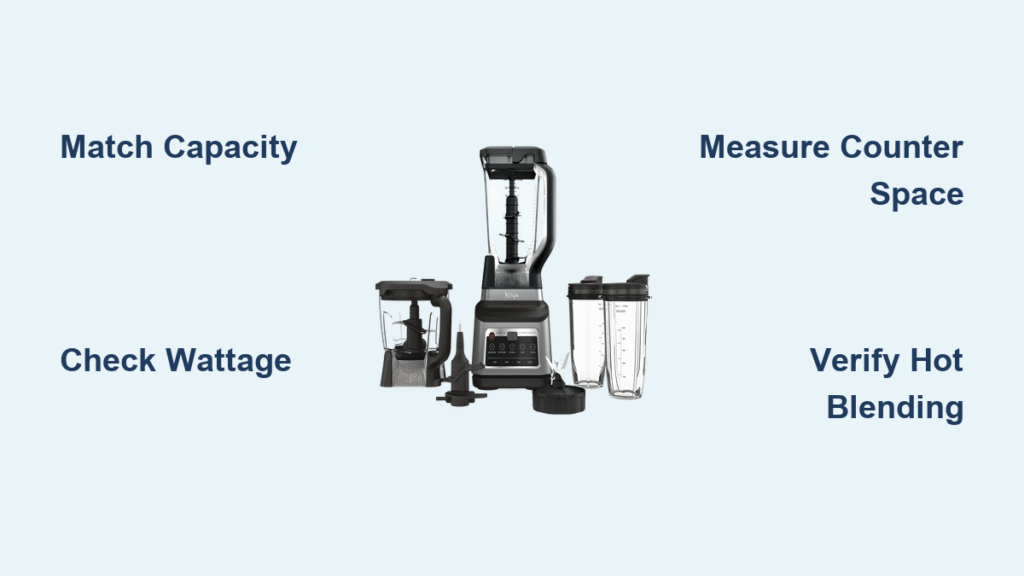
You’re scrolling through endless Ninja blender models, each promising perfect smoothies and soups, but you know the reality: a mismatched blender becomes countertop clutter within months. Maybe you bought a family-sized pitcher only to waste half your smoothie, or a personal cup that can’t crush ice for protein shakes. The wrong Ninja model means daily compromises—underpowered motors leaving kale flecks, bulky bases that won’t fit under cabinets, or accessories you never use. This guide cuts through Ninja’s 20+ models to pinpoint your ideal match based on your recipes, counter space, and budget—no guesswork or returns required. Discover exactly how to choose a Ninja blender that disappears into your routine while delivering flawless results.
Pinpoint Your Blender Type by Daily Routine
Gym Bag Blenders for On-the-Go Crushing
Ninja Blast Max (BC251) transforms car seats and office desks into smoothie stations with its 22 oz capacity and ice-crushing power. Its USB-C charging delivers 7-8 blends per charge—enough for a week of post-workout shakes—but avoid fibrous greens like spinach without shake-and-blend cycles. The standard Blast (BC151) at 18 oz handles basic protein shakes but struggles with frozen fruit. Both weigh under 2 lbs and fit in standard cup holders, but remember: cordless models max out at 100W, making them useless for nut butters or hot soups.
30-Second Morning Smoothie Machines
Personal blenders like the Ninja Fit (QB3001SS) deliver bulletproof reliability for solo drinkers with twist-lock cups that double as travel mugs. Its 700W motor pulverizes frozen berries in 30 seconds (though it hits 95-100 dB—louder than a subway train). Upgrade to the Foodi Power Nutri DUO for $120 if you make thick smoothie bowls; its 1,200W motor and wider blades prevent leafy flecks. Critical tip: Never blend batches under 8 oz in these cups—tiny volumes cause splatter and uneven blending. Always fill to the minimum line marked on the cup.
Family Pitchers That Handle Weekly Meal Prep
When blending for multiple people, 72 oz pitchers like the Professional 1000 (BL610) become essential. Its 1,000W motor smoothly processes frozen fruit for four smoothies at once, but check your cabinet height first—this model stands 15.9 inches tall. For hot soups or frequent nut butter, step up to the Professional Plus DUO with 1,400W power and Auto-iQ presets that pulse automatically. Warning: These large pitchers fail with small batches; never attempt single servings under 16 oz or you’ll get chunky, uneven results.
All-in-One Systems for Serious Home Chefs
Kitchen Systems like the AMZ493BRN ($140) swap between 72 oz pitchers, processor bowls, and single cups—ideal if you bake weekly. Its included dough blade kneads pizza crust weekly, while slicing discs replace your food processor. But storage is critical: these ship with 4-7 accessories requiring dedicated drawer space. The Foodi Ultimate System (SS401) adds tamper tools and suction-cup bases for thick blends, but only choose this if you’ll use 80% of the attachments. Otherwise, you’re paying for clutter.
Bust Ninja Power & Performance Myths

Wattage Isn’t What Matters Most
While 1,000W is the ice-crushing minimum, blade geometry and jar shape impact performance more than raw wattage. The Detect Duo Pro markets 1,800W but tests at 1,200W continuous—yet outperforms higher-wattage competitors due to its removable 3-tier blade design. For nut butter or dough, prioritize models with 1,400W+ like the Twisti DUO or Foodi Power Nutri. Avoid anything under 700W for frozen ingredients; cheap personal blenders stall on ice cubes.
Plastic vs. Glass: The Cold & Hot Exception
Tritan plastic dominates Ninja’s lineup—BPA-free, dishwasher-safe, and shatterproof—but develops cosmetic scratches over 3-5 years. Only the Foodi Cold & Hot (HB152) uses glass, required for its 500W heating element. Crucially, this glass jar cannot be submerged; hand-wipe cleaning only. All plastic jars and blades go straight in the dishwasher (top-rack for lids). Never blend hot liquids above 180°F in plastic models—they risk cracking the jar or melting seals.
Capacity Matching Rules You’re Missing
- Solo servings: 18-24 oz cups prevent over-blending (small batches under 8 oz fail)
- Family batches: 64 oz+ pitchers handle 3+ smoothies weekly
- Dough kneading: Requires dedicated processor bowls (not standard pitchers)
Large pitchers struggle with small volumes, creating vortex gaps that leave chunks. Always match jar size to your typical batch—using a 72 oz pitcher for one smoothie wastes energy and delivers poor texture.
Decoding the Model Maze by Budget
Budget Warriors: Under $100 Workhorses
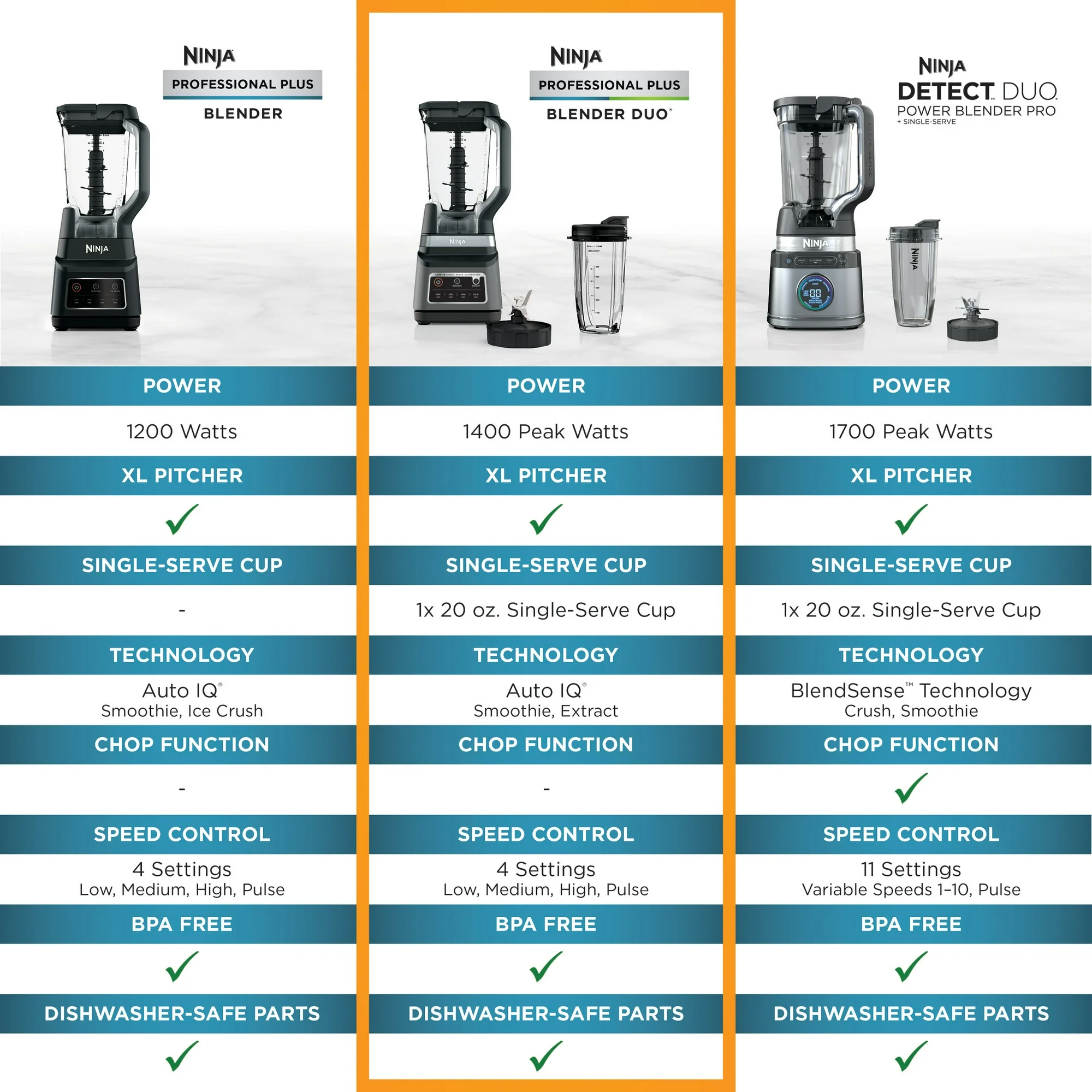
The Ninja Fit (QB3001SS) at $45-$55 is the undisputed value king: 700W power, two 16 oz cups, and pulse-only controls. It lacks presets but delivers 3-5 years of leak-free reliability. The Professional 1000 (BL610) at $80-$90 handles family batches with its 72 oz pitcher but has no Auto-iQ—manual speed control only. Both avoid the “plastic smell” complaints of cheaper brands. Skip models under $40; they lack the motor torque for frozen ingredients.
Mid-Range Sweet Spots: $100-$150
Twisti High-Speed DUO ($110-$120) shines with a built-in tamper for thick nut butters and 1,600W power. The AMZ493BRN Kitchen System ($140-$150) includes a processor bowl for dough at a fraction of premium prices. For long-term value, the Detect Duo Pro ($160-$180) offers a 7-year warranty (register within 30 days) and auto-adjusting BlendSense™ technology. These models balance specialty features without overwhelming accessory clutter.
Premium Powerhouses: $150+
Only invest here if you need niche capabilities. The Foodi Cold & Hot ($150-$200) is the only Ninja that heats—sautéing onions or cooking tomato soup directly in the jar. The Foodi Ultimate System ($200-$270) adds tamper tools and suction bases for serious meal prep. The Detect Kitchen System TB401 ($190-$250) improves on older models with time-remaining displays and leak-proof lids. Avoid these if you only make basic smoothies—they’re overkill.
Avoid Counter Space Catastrophes
Height Hazards Under Cabinets
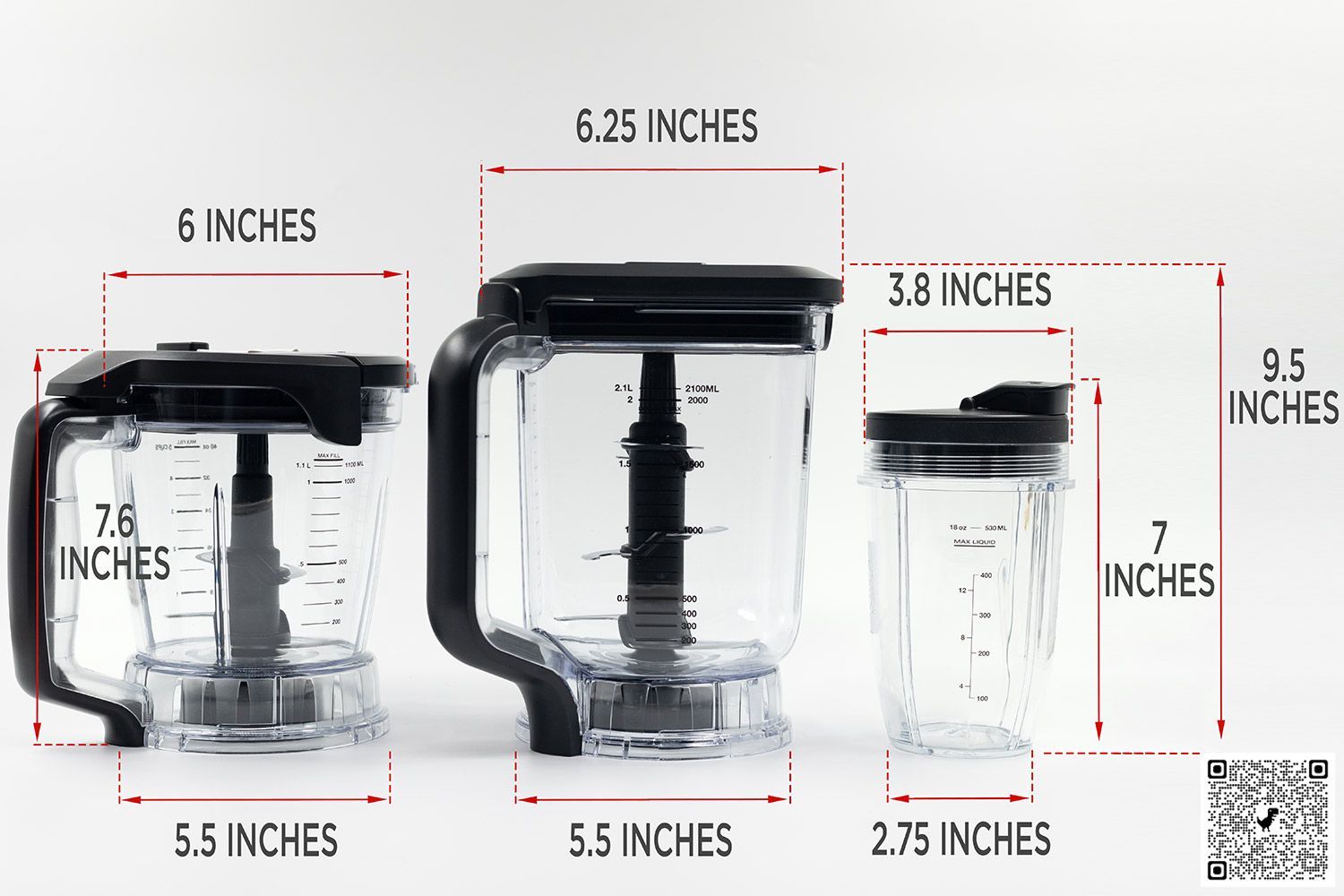
Tall models exceed 16 inches: Professional 1000 (15.9″), Detect Duo, and Mega Kitchen Systems. Compact alternatives like the Twisti DUO (14.5″) or AMZ493BRN (14.8″) fit most standard cabinets. Measure from counter to cabinet before ordering—add 2 inches for lid clearance during use. Portable models like the Blast Max stand just 10 inches tall but require outlet access for charging.
Accessory Storage Reality Check
Kitchen Systems ship with 4-7 parts requiring dedicated space:
– 72 oz pitcher + lid
– 64 oz processor bowl + lid
– 16-24 oz cups + spout lids
– Multiple blade assemblies
– Dough blade and slicing discs
If your kitchen has limited drawer space, skip combo systems. The Ninja Fit requires storage for just two cups and blades—ideal for small apartments.
Match Models to Your Signature Recipes
Ice Crushing Champions
Detect Duo Pro and Professional Plus DUO turn full pitchers of ice into snow in 45 seconds. The Blast Max handles small cubes for single shakes but struggles with large cubes. Avoid immersion blenders and models under 1,000W—they leave slushy chunks. Pro tip: Always add liquid before ice to prevent motor strain.
Nut Butter & Dough Specialists
1,400W+ models like the Twisti DUO or Foodi Power Nutri process almond butter without stalling. For pizza dough, only Kitchen Systems with dedicated dough blades (BL770, TB401, SS401) work—standard pitchers can’t handle dry ingredients. Never attempt nut butter in personal blenders; they overheat within 60 seconds.
Hot Blend Exclusives
The Foodi Cold & Hot (HB152) is Ninja’s only model rated for hot blending above 180°F. Its glass jar and heating element safely cook soups from raw ingredients. All other Ninjas risk cracking with hot liquids—never blend steaming soup in plastic models. This specialty unit costs $50 more but replaces your soup pot.
Price vs. Long-Term Value Analysis
Real-World Pricing Secrets
Ninja models consistently sell 20-30% below MSRP:
– Ninja Fit: $45-$55 (MSRP $60)
– Professional Plus DUO: $150 (MSRP $200)
– Mega Kitchen System: $150-$180 (MSRP $220)
Check Amazon and Ninja’s outlet store for open-box deals. Avoid “refurbished” units—blade assemblies often show wear.
Warranty & Replacement Costs
All models include a 1-year warranty, but the Detect Duo Pro adds 7 years (register online within 30 days). Budget $15-25 every 2-3 years for new blade assemblies—Ninja part numbers are listed in manuals. Cups and lids run $10-20 each if lost. Factor these into long-term costs.
| Your Priority | Choose This Model | Price Range |
|---|---|---|
| Fast solo smoothie | Ninja Fit | $45-55 |
| Gym protein shake | Ninja Blast Max | $80-90 |
| Family smoothies 3x/week | Professional Plus DUO | $150 |
| Weekly bread baking | Mega Kitchen System | $150-180 |
| Hot soups & sauces | Foodi Cold & Hot | $150-200 |
| All-in-one meal prep | Foodi Ultimate System | $200-270 |
Pre-Purchase Checklist
- [ ] Measure counter-to-cabinet height (add 2 inches for lid clearance)
- [ ] Count storage space for accessories (skip combos if <3 spare drawers)
- [ ] Confirm need for hot blending (only Foodi Cold & Hot supports this)
- [ ] Check cup compatibility if upgrading (Nutri cups fit most personal bases)
- [ ] Verify dishwasher claims (Cold & Hot jar requires hand-washing)
- [ ] Register warranty within 30 days for extended coverage
Bottom line: How to choose a Ninja blender comes down to three non-negotiables: match capacity to your typical batch size, verify power for your toughest ingredients (ice = 1,000W+, nut butter = 1,400W+), and measure your counter space before buying. The right model disappears into your routine—delivering perfect smoothies, soups, and sauces without daily frustration. Skip the guesswork; use this guide to pick the one Ninja that earns permanent counter space in your kitchen.